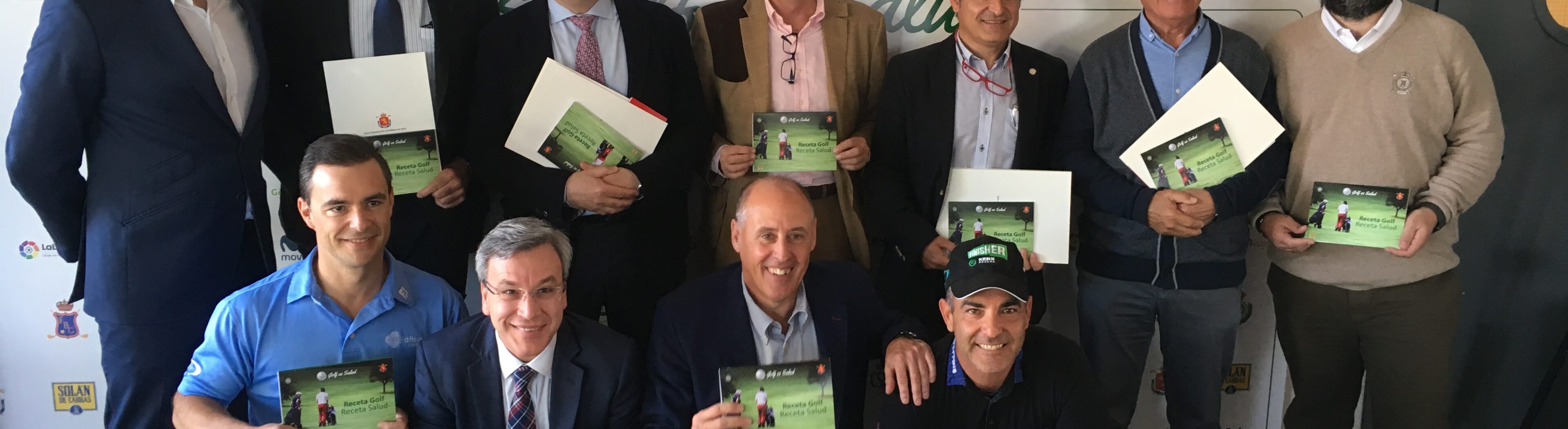
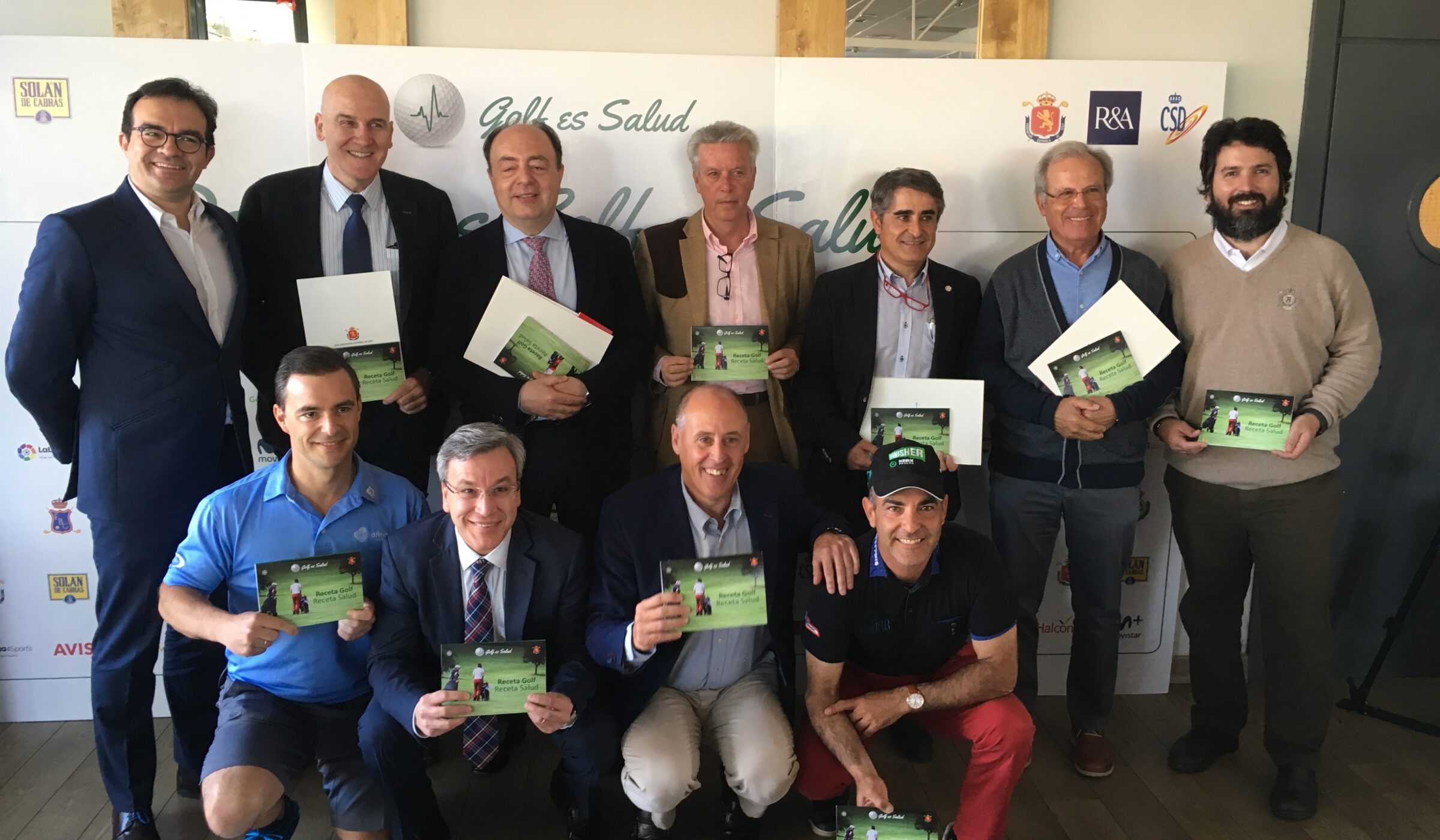
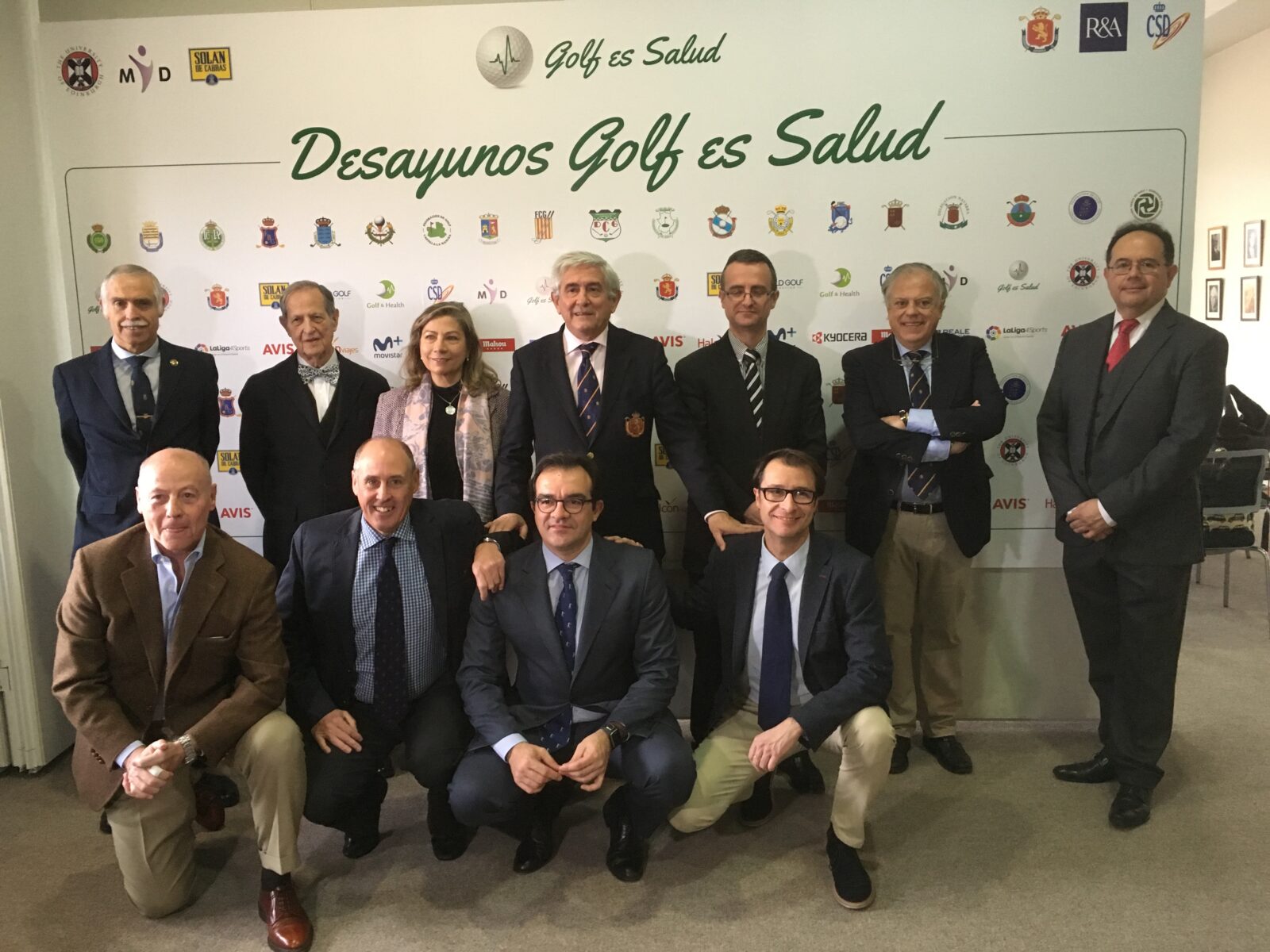
The Royal Spanish Golf Federation, together with Solán de Cabras, has promoted the second session of the Golf is Health Breakfasts, a round table made up of prestigious medical specialists who, periodically throughout the year, discuss the beneficial health effects of playing golf.
Following the presentation by leading cardiologists, several renowned traumatologists took the stage at an event where they all highlighted, in their successive turns, the health benefits of playing golf. From a traumatological perspective, golf is characterized by low injury rates and, when injuries do occur, they are generally of low intensity. Therefore, it is highly recommended for all ages, but especially for those in the older age group where other sports, due to their intensity and physical demands, are beyond the reach of most people.
Golf is Health, a message for society as a whole
The introduction was given by Gonzaga Escauriaza, President of the RFEG (Royal Spanish Golf Federation), who recalled that 'Golf is Health' is a motto that the RFEG and the Regional Federations have adopted to convey to society all the benefits that this sport can offer. "Who better than the specialists to recommend golf, to remind people that golf is healthy and also fun?" he said.
The medical director of Golf es Salud, nephrologist José Antonio García Donaire, was the first of the specialists to speak, and he did so with data. “Sport is longevity; if you don't do it, you die sooner and with worse health, that's what the studies say. Doing sport in a healthy way should start in childhood; that's very important because it can even alter the bad luck we may have had from a genetic point of view,” he explained.
Next, Dr. Ignacio Guerras, who is both a traumatologist and President of the Madrid Golf Federation, raised an important topic: sports-specific injuries. “Golf is a technical sport with a long learning process. If you learn without an instructor, you can suffer injuries, especially those stemming from two factors: the club—related to a poor grip—and the swing, which can cause lower back problems,” he explained.
Dr. Miguel Herrador, a traumatologist at the Cemtro Clinic and a specialist in Sports Medicine, elaborated on the difference between professional and amateur athletes regarding injuries. “Professional sports are always risky. All professional sports have their share of injuries, and golf is no exception. Injuries can be caused by violent movements, which are uncommon in golf, or by overuse, which is more prevalent in golf. We have to do what is appropriate for our age. If we do that, if we act with consistency and common sense, golf is a great sport,” he commented.
In addition to listing the benefits that golf can offer anyone, regardless of age, Dr. Herrador shared a very illustrative anecdote: “The great thing about golf is that a person with a previous injury can practice the sport and improve. I had a hip replacement and within three months my handicap had dropped,” he noted.
“Warming up properly can prevent many injuries”
One of the key topics of the day was the importance of warming up muscles before a sporting activity, and Dr. Mario Padrón, a radiologist specializing in traumatology at the Cemtro Clinic, was the one who brought it up. “Golf rarely causes injuries, but we must emphasize the importance of warming up, since the swing has changed and is now much more biomechanical than before. Our injuries are almost always due to overuse and repetitive strain, never acute, and many of them can be prevented with a proper warm-up,” he explained.
Along the same lines, Dr. José María Silberberg, a traumatologist at the Clínica Universidad de Navarra, made it clear that “what’s not good is rushing around hitting balls in twenty minutes of free time without warming up beforehand. We have to remember that everyone, professionals and amateurs alike, needs to warm up,” the doctor emphasized, adding that golf “is a great sport for children from a mental and social perspective.”.
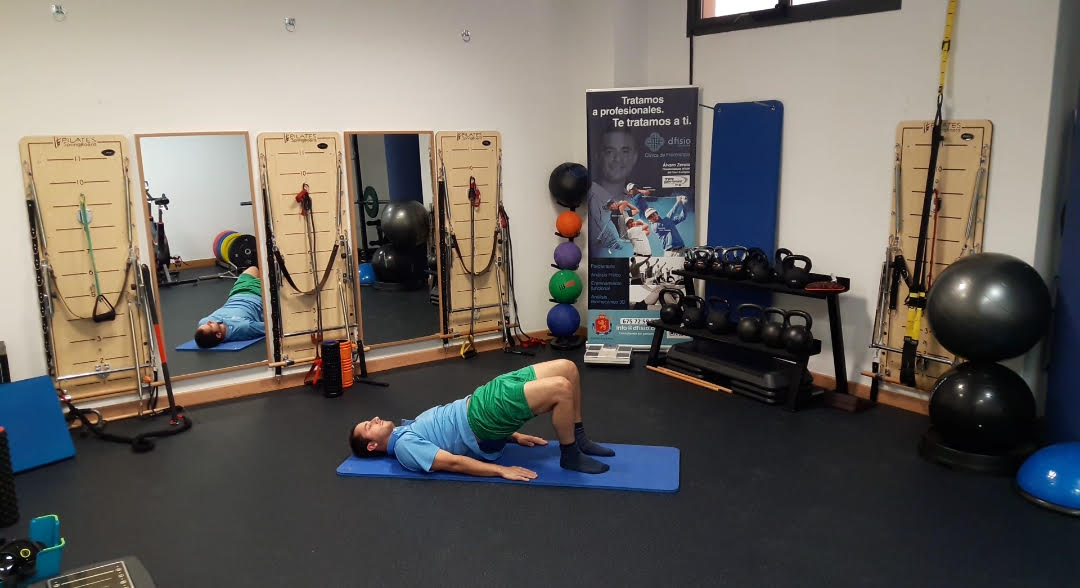
Álvaro Zerolo, physiotherapist for the European Tour and Director of Defisio at the National Golf Center, also emphasized the importance of training routines. “Golf injuries are due to repetition, to overuse. Amateurs are more prone to injuries from poor technique or lack of warm-up. Some people think golf isn't a sport, but it is, and that's why you have to be prepared for strong hip rotation movements,” he pointed out.
Another interesting point emerged from the words of Dr. Ricardo Crespo, Head of Traumatology at La Mancha Hospital, who compared golf to other sports in some aspects. “Many players come to golf already with pre-existing injuries, such as osteoarthritis, and these are injuries that don't worsen from playing; it's important to remember that. Furthermore, it should be emphasized that golf injuries are not particularly serious. They usually heal easily, provided the recovery time is respected. It's very rare for someone to have to give up golf because of these injuries,” he added.
For his part, Dr. Alfonso del Corral, a traumatologist with many years of experience in elite sports and a former professional basketball player, emphasized that “physical preparation is essential to reduce the risk of injuries. A lot of strength training is necessary to perform certain movements that professionals can do. That much is clear. But golf is fantastic, especially for mental well-being, and given the current demographic trends, it will become even more important in the future. We are moving towards a society with many retirees who have free time, and that time needs to be filled. That's where golf comes in as a highly recommended activity,” he explained.
“Golf is healthy, but also fun.”
Also of interest was the perspective of Dr. Fernando Jara Sánchez, Head of the Traumatology Department at the 12 de Octubre Hospital and Head of Medical Services for the Madrid Footballers' Mutual Society. In his opinion, prescribing golf should be easy, "since many doctors play and are familiar with the benefits of this sport. Swimming, cycling, and other sports are often prescribed, but golf is equally beneficial.".
“Golf is a very attractive alternative for those of us approaching retirement. It’s a moderate and fun sport. Personally, I find a stationary bike very boring, and for people like me, who were athletes when we were younger, golf can be a great option in retirement,” he explained.
Another interesting perspective is that of the professional player, offered by Carlos Balmaseda, a golfer with a long and successful career who has also been plagued by back injuries. “We see that players are now much better prepared physically. Fortunately, amateurs are increasingly aware of the importance of warm-up and physical conditioning. I see this now that I'm working with the children at the Villa de Madrid Country Club,” he stated.
Pablo Cabanillas, President of the Adapted Golf Committee of the Madrid Golf Federation, also contributed his perspective, noting that golf injuries are more frequent when dealing with people with disabilities, "whether due to a bad twist, a different turn..."“



 (2)-1600x1200.jpg)