
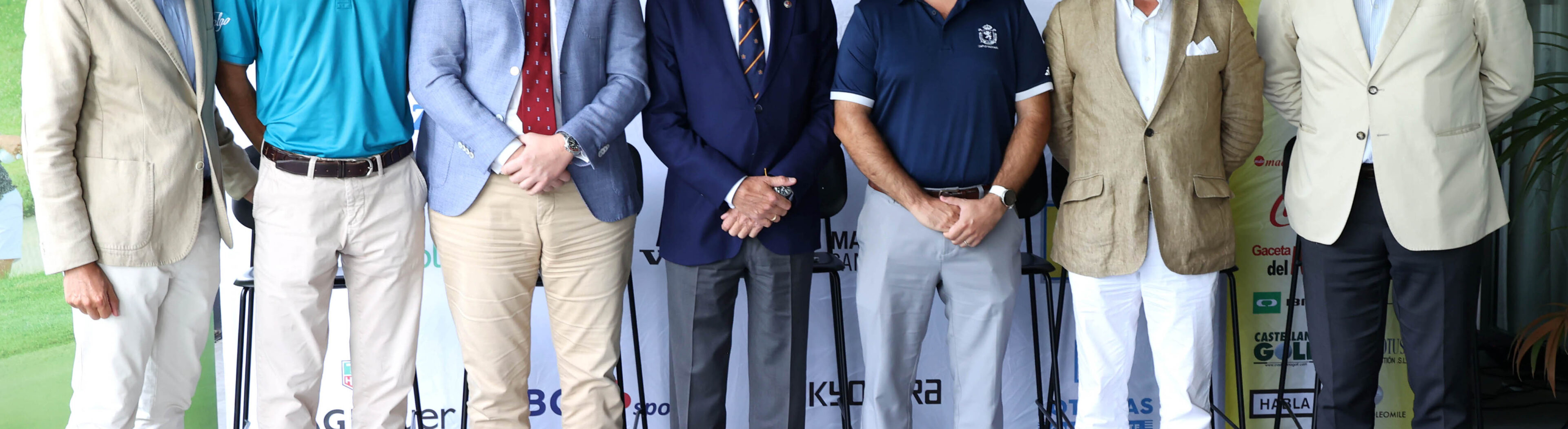
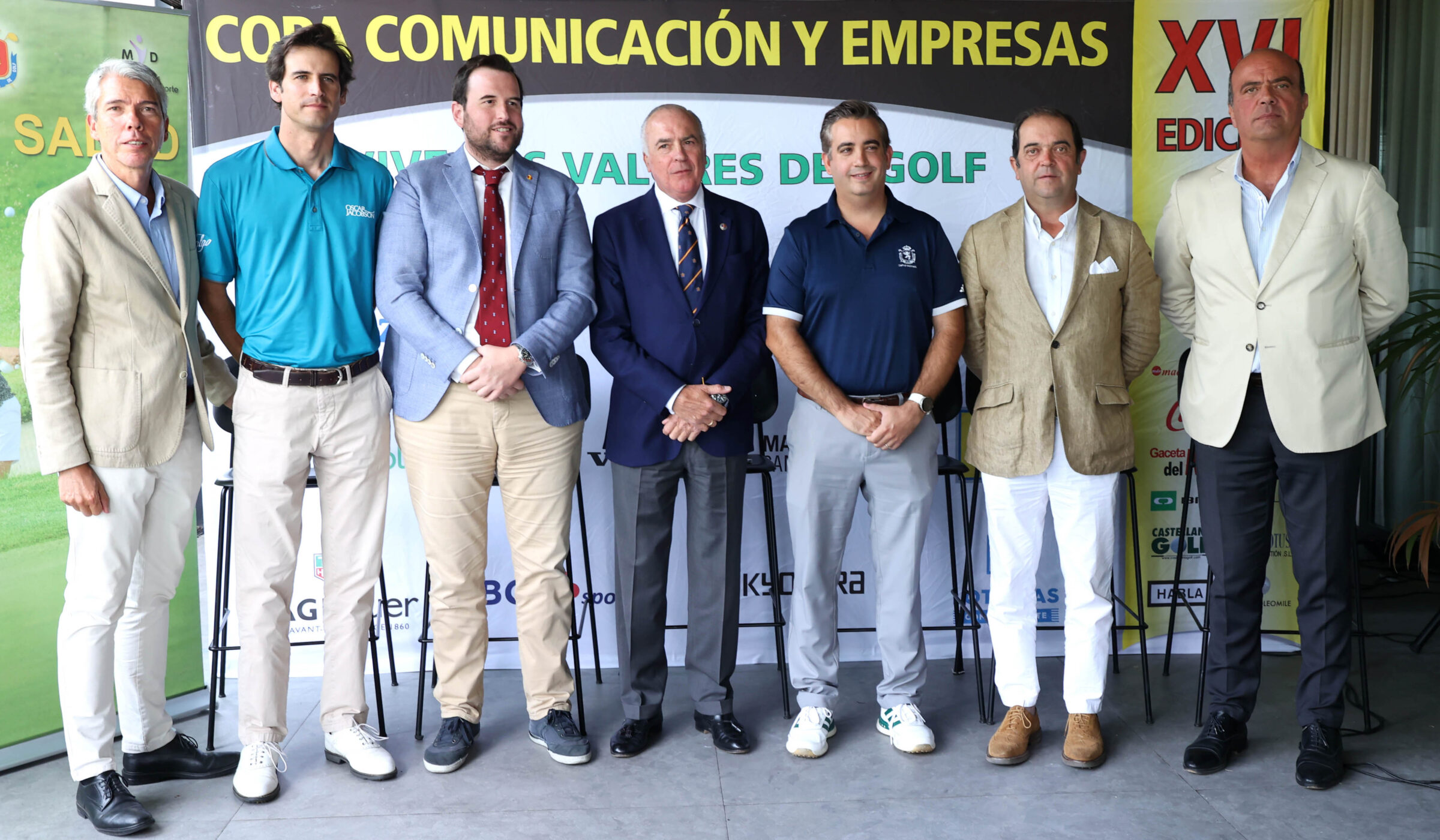
.Luis Fernández-Conde, International Judge-Umpire; Pedro Oriol, professional player; Jesús Barrera, Sports Director of CC Villa de Madrid; and course managers Juan Antonio Fernández (National Center) and Goyo González – Irún (Olivar de la Hinojosa) and Nacho Vidosa, sports director of RACE, offered their experience in relation to slow play
What is meant by slow play and why does it occur; slow play in the competitive and recreational game; slow play by age and handicap categories; slow play in professional competitions; how the problem of slow play is addressed on golf courses of different types… all these issues were the subject of debate at a new event of the Communication and Business Cup.
On this occasion, with the aim of spreading the values of golf in different areas of Spanish society, the Communication and Business Cup has addressed an issue that affects the whole of world golf with an educational and constructive spirit, with the desire to find common ground.
Juan Guerrero-Burgos, Secretary General of the RFEG, welcomed all those present, emphasizing "the good health of Spanish golf, with continuous sporting successes and once again above 300,000 registered members" before praising the work of the golf clubs as a whole and the media in their work of disseminating the actions of the entire Spanish golf community.
Luis Fernández-Conde, International Judge-Umpire; Pedro Oriol, professional player; Jesús Barrera, Director of Sports at CC Villa de Madrid; and the course managers Juan Antonio Fernández (National Center) and Goyo González – Irún (Olivar de la Hinojosa) and Nacho Vidosa, sports director of RACE, offered their great experience in relation to slow play.
The first to speak was Luis Fernández-Conde, an international referee, who began his address by noting that “there is no definition of slow play in the Rules of Golf. It refers to playing 'without undue delay and at a normal pace of play,' but there is no definition as such.‘.
Having noted this, Luis Fernández-Conde pointed out that slow play “is fundamentally a matter of education,” and explained that “younger players are faster than many older ones, mainly because they aren’t influenced by golf on television, as is the case for many amateurs. When we see professionals on TV taking ten minutes to putt…”.
Next, Pedro Oriol, a player with experience on the DP World Tour and the Challenge Tour, focused on professional players. “On the PGA Tour, it takes five and a half hours. If the most important tour doesn't combat slow play, we're starting from a very bad position. The tours themselves are partly to blame, although the European tours are much more vigilant about slow play. We professionals have to understand that we are the role models for the fans,” he argued.
To gain a comprehensive understanding of the consequences of slow tee times in golf, the perspectives of golf course managers and directors were essential. The first to speak was Jesús Barrera, Sports Director of CC Villa de Madrid, who acknowledged that it is a “very complex” issue, especially at clubs with many tee boxes. He offered a thought-provoking observation: “The idea that high handicappers play slowly and low handicappers play quickly is a misconception I'd like to dispel, because it's not necessarily true.” He also emphasized the often thankless work of the marshals.
For his part, Goyo González-Irún, Manager of Olivar de la Hinojosa, spoke “from the perspective of a commercial course, where the proportion of season ticket holders is very small. The problem here lies in having to complicate things for a customer who spends money to play on your course. We have to find a balance, but let's admit it's complicated.”.
“It’s not about playing fast, it’s about playing agilely.”
Juan Antonio Fernández, Manager of the National Golf Center, then took the stage, speaking from the perspective of a public course open to pay-and-play. “The conflict here is clear: we want people to have a good time, but we also want to make sure they don't spend too much time on the course. At the Golf School, we try to educate the students about this, and to do so, we block out tee times so the instructor can go out with the students and teach them things like the pace of play. We tell the students that they shouldn't play fast, rushing, and in a hurry; they should play with agility.”.
The last to express his viewpoint was Nacho Vidosa, Sporting Director of RACE, a leading club in Spain with unique circumstances due to its strictly private nature. “We have 21,000 members, each with their own situation. Time is one of the few things in life that can't be recovered, which is why we believe it's vital and something we must work on. In addition to what's already been said, we can do things to improve the players' speed: proper course preparation, appropriate pin placement, and so on,” he pointed out.
The day concluded with a discussion interspersed with questions from the attendees. “An unsolvable problem? Not at all,” Luis Fernández-Conde interjected, “but measures must be taken. At RACE, we got to work and have improved compared to our initial situation.”.
In conclusion, a consensus was reached: golf education and pedagogy, especially regarding beginners, appear to be the main weapons in the fight against this problem plaguing our sport. The RFEG, through its Sports Technician courses, is already ensuring that instructors teach their students the importance of playing with rhythm, as Pedro Oriol emphasized.
Check out the photo gallery below, in the Related Links section.

-1600x1200.jpg)
-1600x1200.jpg)