Improving existing pipelines and constructing new ones are key to providing golf courses with access to reclaimed water: this is the resounding conclusion reached at the conference 'Sustainability in golf courses: reclaimed water', since the vast majority of Spanish golf courses (70%) irrigate with reclaimed water unsuitable for human consumption, and those courses that do not are due to a lack of pipelines, which prevents access to said water.
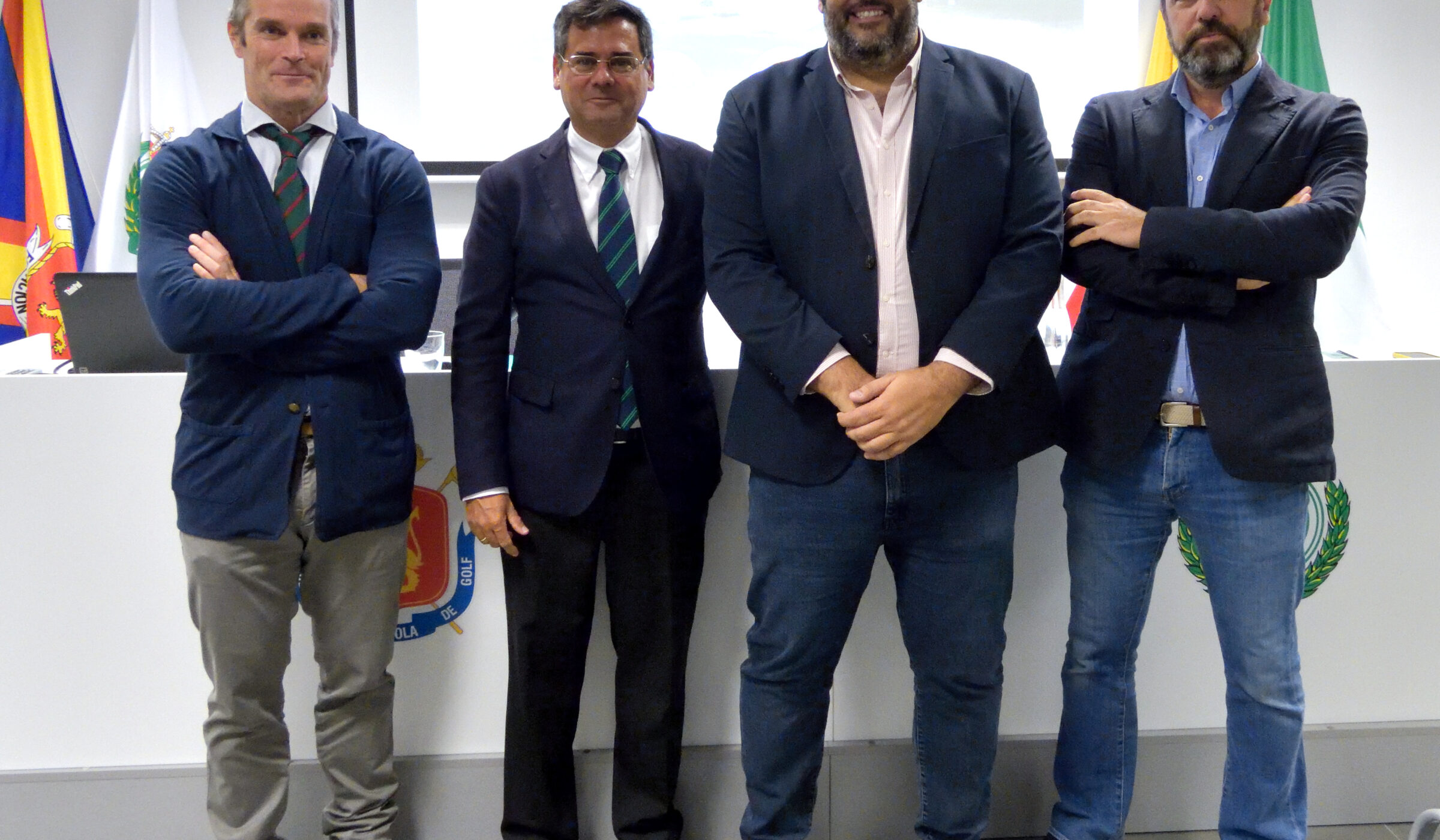
Under the title 'Sustainability on golf courses: reclaimed water', the Royal Andalusian Golf Federation (RFGA), together with the Spanish Association of Golf Courses (AECG), and the Spanish Association of Greenkeepers (AEdG), and in collaboration with ACOSOL (public water company of the Association of Municipalities of the Western Costa del Sol), have organized a conference at the federation headquarters to highlight the sustainability of golf courses by emphasizing the use of reclaimed water. More than fifty people attended, including owners and managers of Andalusian golf courses, as well as representatives of companies in the sector and personalities from different public and private entities.
The day began with a welcome address from the president of the Royal Andalusian Golf Federation (RFGA), Pablo Mansilla, who highlighted the golf industry's crucial role in water resource management, stating that "golf courses represent only 0.31% of the total irrigated land area in Andalusia. Furthermore, 801% of that irrigation is carried out using recycled water, making the golf industry a pioneer in water reuse and a key driver of wealth and job creation.".
Next, a round table discussion took place with the participation of Carlos Cañavate, CEO of ACOSOL; Carlos Pitarch, Vice President of the Spanish Association of Golf Courses (AECG) and Javier Gutiérrez, Member of the Spanish Association of Greenkeepers (AEdG).
Carlos Cañavate emphasized that “at Acosol, we continue working and investing in improvements to the service and the infrastructure that allows us to irrigate fields with reclaimed water, as this resource is becoming increasingly necessary due to the lack of rainfall, rising temperatures, and ultimately, climate change. Therefore, these kinds of events are vital for addressing the sector's needs and working together to seek investments that promote the use of reclaimed water and strengthen our commitment to sustainability and environmental protection.”.
According to Carlos Pitarch, “the pipeline construction initiated in the 1990s to bring reclaimed water to golf courses is the best example of public investment in the sector, enabling a more sustainable golf industry that also generates wealth and employment thanks to the tourism it produces, which benefits courses, hotels, restaurants, shops, leisure activities, etc. In this sense, European funds could contribute to continuing the path of sustainability in golf by investing in new pipelines.”.
Finally, Javier Gutiérrez pointed out that “the use of reclaimed water by golf courses means gaining independence from environmental conditions, rainfall, and periods of drought. It provides a secure and constant supply, but its quality is its main limitation. This quality, even considering that it has traditionally been good on the Costa del Sol, places additional stress on the management of some areas of the golf course (greens, for example). However, with the deterioration of supply infrastructure in recent years and the lack of investment and renovation of many golf courses, the survival of these areas is becoming increasingly complex. This situation is exacerbated each year by rising temperatures and restrictions on the use of pesticides.”