. Spanish golf courses are implementing actions aimed at protecting the environment and reducing water consumption, using 70% of recycled water unsuitable for human or agricultural use.
. Gonzaga Escauriaza, President of the RFEG, and Luis Nigorra, President of the AECG, highlight the initiatives championed by Spanish golf during the ACCIONA Open de España, an example of a sustainable sporting event promoted by Madrid Trophy Promotion and ACCIONA.
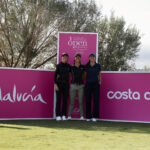
The golf industry as an example of sustainability and good water use is the message that Gonzaga Escauriaza, President of the RFEG, and Luis Nigorra, President of the AECG, have launched to highlight the actions championed by Spanish golf during the celebration of the ACCIONA Open de España, an example of a sustainable sporting event promoted by Madrid Trophy Promotion and ACCIONA, represented by Gerard Tsobanian and Joaquín Mollinedo, respectively.
Concepts such as erosion and sedimentation control; soil conservation and improvement; recharge of underground aquifers; temperature regulators; adsorption of sulfur dioxide and prevention of acid rain; favorable habitat for the development of fauna and containment against fires underlie the day-to-day operations of Spanish golf courses, which are investing increasing resources in increasing the sustainability of these facilities.
Special mention in this regard goes to the introduction of new turfgrass varieties with lower water requirements, irrigation control systems in specific play areas, and the role of golf courses as natural firebreaks – as was evident once again this summer – thanks to the use made by firefighting aircraft of the lakes, which commonly serve as natural reserves for thousands of birds migrating through Spain.
Tree planting, solar panel installation, creation of electric communities, and the use of artificial grass on practice fields are actions that, as Gonzaga Escauriaza explained, are already being implemented on Spanish golf courses as well as at the National Center.
Another important topic was water consumption, where participants emphasized the need to separate golf course irrigation from the water problem. Indeed, these sports facilities mostly irrigate (70%) with reclaimed water unsuitable for human consumption, which undergoes tertiary biological treatment for reuse on the golf courses instead of being discharged into aquifers or directly into the sea, with the resulting environmental problems.
It should be remembered in this regard that the National Water Pact does not include the consumption of golf courses, considering it insignificant compared to that which is carried out either sectorally or globally.
In this regard, figures emerged – the direct and indirect economic impact of golf amounts to more than 12 billion euros annually; Spain attracts 1.2 million foreign tourists and consolidates its position as the world leader in receiving international golf tourism; the sector generates more than 120,000 direct and indirect jobs, the vast majority of them high-quality; 7 out of every 8 euros (1.88%) produced are generated outside of golf courses, impacting other sectors, such as services – which highlight the contribution of the golf industry to Spanish society as a whole.
Gonzaga Escauriaza, President of the RFEG (Royal Spanish Golf Federation), stated that “the high number of courses using reclaimed water unsuitable for human consumption contributes to wealth creation, as it enables an activity that helps to reduce the seasonality of tourism. We therefore request that the authorities support the golf industry, which has demonstrated a clear environmental awareness for years, resulting in social and economic benefits, as it contributes more than 5.6 billion euros directly to Spanish society as a whole.”.
The President of the RFEG also emphasized that, regarding certain reports, “our job is not to respond to certain things. We hear criticisms that are outright fallacies, lies. In this sector, we are constantly working to improve, and overall, we are very beneficial to society. We need to focus on communicating the advantages of golf, on highlighting cases like the National Center, which has become a wonderful green space. That's who we are, and we have very compelling arguments.”.
For his part, Luis Nigorra, President of the Spanish Association of Golf Courses, emphasized that “golf helps to reduce seasonality since it is mainly played outside the summer months, which helps make tourism more sustainable by promoting activity outside the ’sun and beach” season. This allows complementary activities to benefit and operate for many more months. It's also important to remember that golf is a tourism product with a significant multiplier effect, as golf tourists spend seven out of every eight euros outside the golf course.”.
The President of the AECG explained that “the issue of water must be addressed at a regional, not national, level. We are all concerned about the drought, but the focus should be elsewhere. Every day, six times the amount of water consumed by all golf courses is lost in the distribution networks, and this water is potable. Therefore, when we talk about drought, we shouldn't be looking at golf courses, which, I reiterate, mostly use recycled water unsuitable for human consumption.”.
In his remarks, Gerard Tsobanian, CEO of Madrid Trophy Promotion and the tournament's driving force, stated, “There is a need to fulfill our responsibilities. This initiative began in 2020, but it's a long process that we take very seriously. We either do things right or we don't do them at all. Sustainability is in the DNA of Madrid Trophy Promotion, and that's why we've partnered with specialists in the sector, such as the engineers at ACCIONA. We see things like drought, storms, hurricanes… which lead us to believe that we have to contribute in some way. For example, at this tournament you won't find any plastic, our cars are electric, we don't use paper, the fences are recyclable, and next year we're working on a living fertilizer that doesn't harm the soil in any way… we take realistic measures; we don't do marketing.”.
Finally, Joaquín Mollinedo, Director General of Institutional Relations, Communication and Brand at Acciona, emphasized that “we have always been interested in sport because of its values. We wanted to bring the message and commitment to sustainability to sport: ours was the first electric car to finish the Dakar Rally, for example. From the outset, we all understood that we had to create a sustainable event, so that everyone who comes knows that it is not only a competitive event, but also encompasses a message and a commitment. And this translates into real and concrete measures that are measurable and that transform the environment from a social perspective, such as electric mobility, clean energy generation, energy efficiency, other biodiversity protection measures, waste collection plans… In addition to achieving a positive balance in terms of CO2 emissions.”.
RELATED NEWS
SUSTAINABILITY: Environmental benefits of a golf course
The RFEG applies technological innovation systems to save water in the irrigation of golf courses
How to achieve efficient water management on golf courses – Conference at La Herrería
Pilot project to convert golf courses into nature reserves
Study to improve drought resistance of turfgrass
A golf course, once again, helps in extinguishing fires
National Golf Centre: a more sustainable and fun golf course
The National Water Pact considers the consumption of golf courses to be insignificant.