The Adapted and Inclusive Golf Committee of the RFEG has promoted a training webinar in which authoritative voices in accessibility and inclusive sport have shaped a common idea: the need to enhance people's abilities above their disability.
The webinar began with a brief introduction by Gonzaga Escauriaza, President of the RFEG, and Francisco Centeno, President of the Adapted and Inclusive Golf Committee, which led to the first of the two presentations of the day, by Raúl Núñez, accessibility consultant and consultant of Ilunion Technology and Accessibility, who emphasized raising awareness of disability.
Raúl Núñez began his speech by emphasizing one idea: “When we talk about disability, we sometimes refer to it as a limitation, but we have to remember that we are talking about a huge and diverse group. We need to talk more about abilities and less about disability. In fact, the new logo for the disability university no longer emphasizes limitations,” he explained.
“At some point in our lives, we all live with a disability.”
“Human beings possess physical, intellectual, and sensory capacities. The sum of these three is what helps us relate to our environment, and when one fails, that's when we talk about disability. This concept is important because we all experience disability at some point in our lives, whether it's due to a sports injury, not knowing the language of a country, and so on,” she pointed out.
Furthermore, Raúl Núñez invited the virtual attendees to eliminate labels and prejudices, and not to be afraid of disability, “because we will all live with it at some point. We need to focus more on developing abilities rather than limitations. And of course, we must eliminate the term 'disability'—as well as 'useless' or 'crippled'—from our way of thinking, because no one is less valuable than another,‘ he stated.
“Another important concept is accessibility, which means adapting the environment to our abilities. We must eliminate barriers to ensure equal opportunities for everyone,” concluded Raúl Núñez.
“The ”it can’t be done’ doesn’t exist for us; it will be done differently.”
The second presentation was given by Miguel Dorronsoro, technician of the Adapted and Inclusive Golf Committee since 2008, who focused on adapted golf as a sporting modality.
“When we talk about golf for people with disabilities, one gets scared, 'what can I contribute to the classes if I have no experience?' I thought. Thanks to the Sport and Challenge Foundations, and Sergio García, we were able to count on the coach Peter Longo, who explained to us what his experience was like with people with disabilities and helped us,‘ he explained.
“Our pillars as a committee are the promotion of inclusive sport and the search for players who want to play in our competitions. We want to expand our group to aspire to surpass what we have already achieved,” he said.
Migue Dorronsoro pointed out that “some tournaments require a Medical Pass, while others are 'Access' category, and the National Team, which represents us in European tournaments, is selected from these. We have all kinds of players here, whom we simply call 'players,' each with their own abilities. That's where the handicap comes in, the leveling factor in golf. 'It can't be done' doesn't exist for us; it will be done differently,‘ he concluded.
Juan Postigo: “It’s a sport that instills discipline in you.“
Following this, Juan Postigo, a player on the National Adapted and Inclusive Golf Teams, and athletes from other disciplines, such as triathlete José Luis Gómez and athlete Desirée Vila, along with Gonzaga Escauriaza and Francisco Centeno, held a press conference in which they explained their sporting experiences.
Juan Postigo, three-time European champion, recalled the figure of his grandfather, who introduced him to golf and its values. “It’s a sport that instills discipline and helps you to know yourself, to relate to those you compete against, to be punctual… these are important things,” he said.
Desirée Vila, who lost a leg six years ago, explained that after her accident she had to decide how to adapt to this new reality. “My leg wasn’t going to grow back, so I had to adjust to my new life, and that’s what I did,” said the Olympian in Tokyo, where she earned a diploma.
For his part, José Luis Gómez noted that his best experience in his successful sporting career was at those same Olympic Games. “What you experience there is incomparable,” he remarked. “I loved golf when I played it occasionally, and it has the added bonus of being played outdoors. I’ll be returning to it soon, among other reasons, so I can beat my brother-in-law,” he joked.
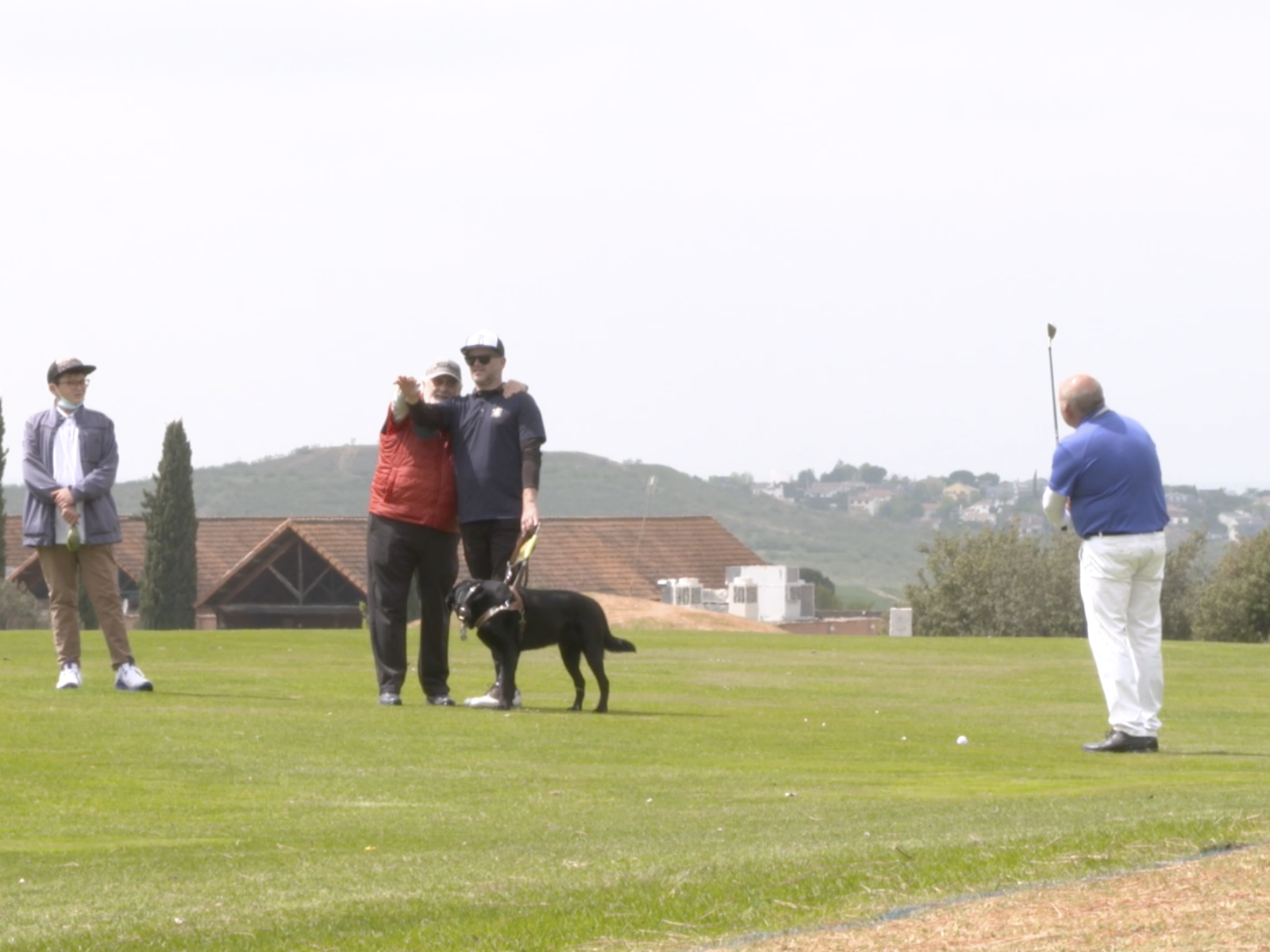
The three athletes finally played an exhibition hole at the National Golf Centre.