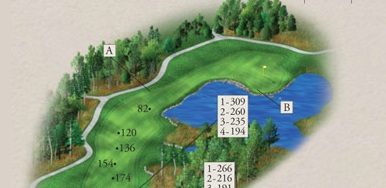
The second hole at TPC Boston is a 495-meter par five with a water hazard near the green. Watney, who started the day three strokes behind the leader, played a two-to-the-green and overshot it. He then attempted a chip shot that also overshot and ended up in the water hazard near the green.
After attempting to play his fourth shot from inside the hazard and being unable to get the ball out, Nick decided to apply Rule 26-1b by dropping a ball outside the hazard with a one-stroke penalty. This required him to “drop a ball behind the water hazard, keeping the point where the original ball last crossed the margin of the water hazard in a straight line between the hole and the point where the ball is dropped, with no limit as to how far behind the water hazard the ball may be dropped.” This led him to drop the ball about 100 meters from the hole, leaving the water hazard between the ball and the hole, even though his ball had entered the hazard from the margin bordering the green.
Since the hazard was marked in yellow, the only relief option he had to play the ball from outside the hazard, besides the one he chose, was to repeat the shot from where he had made the shot that led him to the hazard, which didn't seem very appealing. He could also, applying Rule 26-1a, have dropped another ball with a one-stroke penalty inside the hazard where he had made the previous shot, but this option seemed the least attractive of all, given the outcome of the previous shot.
So Nick played what he thought was his sixth shot from about 100 meters from the hole, taking the ball to the green and finishing with three putts for an "outstanding" nine.
However, after making his fourth stroke from inside the hazard, and while the ball was still lying in the hazard, Watney angrily struck the ground of the hazard with his club, breaching Rule 13-4, which states that, “before making a stroke at a ball that is in a hazard (whether a bunker or a water hazard)… the player shall not… (b) Touch the ground in the hazard, or water in the water hazard, with his hands or a club…”
Indeed, Decision 13-4/35 states:
13-4/35 Hitting the sand in the bunker with the club after failing to get the ball out
PA makes a bunker shot and does not get the ball out of the bunker. He then hits the sand with his club, although his action does not affect the new lie in the bunker. However, since A has to play another bunker shot, has he breached Rule 13-4?
Yes. None of the exceptions to Rule 13-4 apply to A's action.
In Watney's case, it was a water hazard, and the ground of the hazard, but the decision applies equally, so Watney had to add two penalty strokes to his score for that hole, ending with a more than outstanding score of 11 strokes on that hole.
If you want your knowledge of the Rules to stand out, visit the Rules section of rfegolf.es frequently.