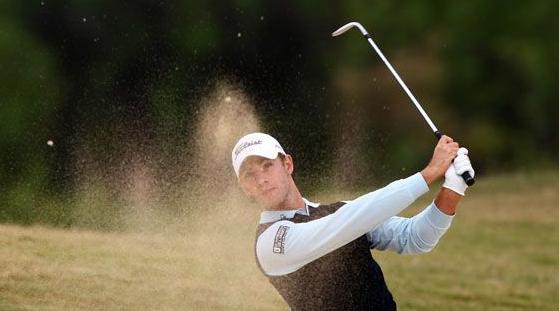
During the first round, before starting play on the third hole, Tano Goya decided to change the ball he had used on the previous hole. His caddie took a new ball from his bag, with which Tano managed to make birdie on the third and par on the fourth. However, when he took the ball out of the hole on the fourth hole, Goya realized he had a problem.
Rule 15-1 states that “a player must finish the hole with the ball played from the teeing ground unless the ball is lost or out of bounds or the player substitutes it with another ball, whether or not such substitution is permitted (see Rule 15-2).” This means that, unless a specific Rule applies, the hole must be finished with the same ball that was played from the teeing ground. However, it also means that, at the teeing ground, before starting the hole, the player can indeed change balls, as Tano did.
So what was worrying Goya?
A fairly common competition condition in professional competitions, and in force in European Tour competitions, is known as the "one ball condition".
This does not mean that players must play the entire round with a single ball without being able to change it, but rather that, if they do change it, they must always use the same brand and model of ball throughout the entire round. Specifically, the competition rules state:
“During a stipulated round, the balls played by a player must be of the same make and model as those listed once (in an entry) on the current Approved Golf Ball List.”
The penalty for breaching the Rule in stroke play is two strokes for each hole in which the breach occurred, with a maximum penalty of four strokes. However, once a player is found to have breached this Rule, they must abandon that ball before starting the next hole; failure to do so will result in disqualification.
What Tano discovered when he retrieved the ball from the hole was that the ball his caddie had given him on the 3rd tee was not the same make and model as the one he had started the round with. As a result, Goya had to add four penalty strokes to his first-round score, finishing the round three over par.
Tano, who was the only one who could have realized his transgression, provided the necessary act of integrity for the film's script. The happy ending was still to come, and it would arrive on the second day.
On the second day, the cut was set at two under par. Tano was making up strokes, but not enough to overcome the four penalty strokes from the previous day.
Thus, after teeing off on the 18th hole, a 392-meter par four, Tano found himself three under par, even par overall, two strokes shy of the cut. Needing a miracle, or a dramatic finish, Tano managed to sink his second shot, making the necessary Eagle to secure his place on the cut. A truly cinematic ending worthy of Goya.
If you don't want to be misled when applying the Rules, visit the Rules Section from rfegolf.es.