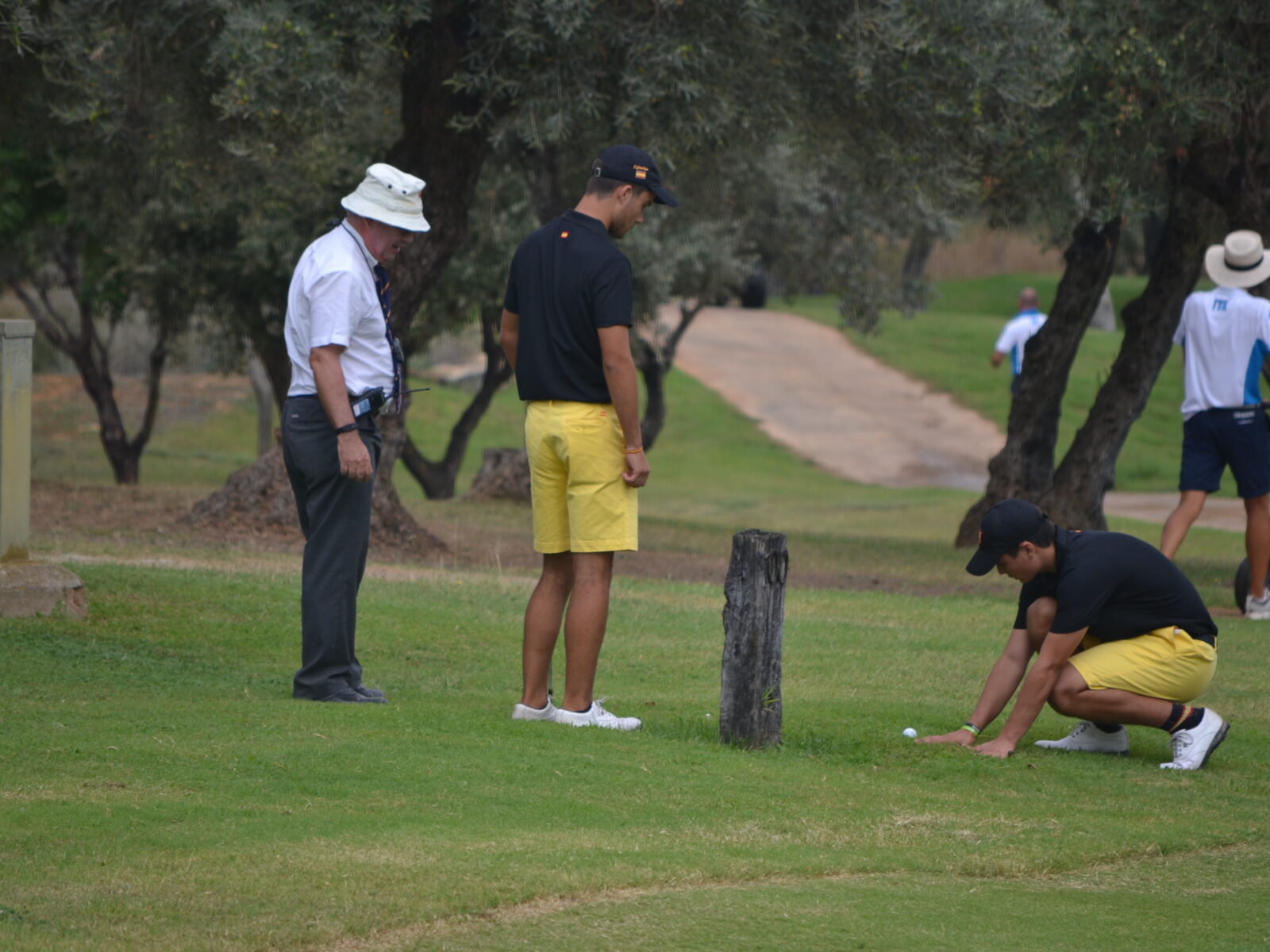
The RFEG Rules Committee has prepared a series of articles to further promote and teach the Rules of Golf and to ensure that playing our sport is as enjoyable as possible while always adhering to current regulations. The third article deals with the duties and responsibilities of the scorer.
Obligations and responsibilities of the scorer
“Today is going to be a good day of golf. I have my tournament tee time at 10:00 a.m. and I'm playing in the same group as Javier and Rosa. I know Javier better, because our children go to the club's golf school together… We have a couple of holes left. I'm having a great time and I'm even playing quite well…”
No!! I just saw Javier subtly move his ball in the rough. I think, "Wow, you can't do that!!" Rosa's distracted and didn't see it. Ugh, what a situation! It's so awkward. I'm her marker, but I'm not going to make things complicated.
When I finish the hole, I ask him; he tells me he made 5 and doesn't say anything else. I sign his scorecard; after all, I came here to have fun… At the club, they applaud Javier when he collects his prize for second place in the tournament…”.
A scorer's role isn't simply to ask a player how many strokes they took on each hole, record them on the scorecard, and sign it at the end of the round. That's clearly not the scorer's function; they have a series of obligations and responsibilities that should prevent situations like the one described earlier.
It's curious, but the marker is given more responsibility than he actually has, and it's very common to hear that "I dropped because my marker authorized it", as if the marker's opinion, especially in the application of the rules, had a special status.
Nothing could be further from the truth, since the scoreboard is not a referee and we cannot delegate to it the decision on the application of the rules.
On the contrary, there are certain responsibilities that are exclusive to the scorer: recording a player's result on their scorecard and certifying the scorecard.
For this to happen, the marker must remain with the player for the entire round, and if the marker is absent during any hole, then the scorecard cannot be certified correctly.
In such cases, the player must insist that the marker accompany him on all holes, and if this is not possible, he must ask another person to act as marker. If it is also not possible to find another person, the player is obliged to stop playing and inform the Committee so that another marker can be assigned (Int. 3.3b/1).
In stroke play, the role of the marker is fundamental to the development of the game, and rule 3.3b explains what their obligations are:
. Confirm with the player, after each hole during the round, the number of strokes on that hole (including strokes made and penalty strokes)
. Record the player's results on their card
. Upon completing the round, verify the scores recorded for each hole on the scorecard.
Therefore, it is not a good habit, which is curiously very widespread among younger golfers, to not check and record each hole individually, but to write down all the results when the round is over, relying entirely on memory.
Nor is it acceptable to sign the scorecard at the start of the round, trying to avoid forgetting to do so at the end. As we have seen, neither of these scenarios complies with the rule.
And going back to the incident we discussed at the beginning: What happens if a scoreboard fails to fulfill its obligations and certifies a result that is not correct?
In that case, the rules tell us (Int. 3.3b(1)/1) that if a marker knowingly certifies an incorrect result on a hole, even if it is by omitting some type of penalty that he knew should be included for that hole, the marker should be disqualified for gross misconduct.
So what should someone do who finds themselves in a similar situation, and knows that the player's outcome is different from what they intend to deliver?
When there is a dispute or difference of opinion between the player and his marker regarding whether there has been any infringement of the rules or regarding the player's result on a hole, the marker is not obliged to certify the result of the hole which he believes to be incorrect, so the Committee should be informed of such disagreement so that it can make a decision (Int. 3.3b(1)/2).
So, we already know that when we take on the role of marker, we have obligations and responsibilities that commit us to the game and the rules, which is perfectly compatible with enjoying golf.
By Manuel Gª Mancebo
National Judge-Referee



-1600x1200.jpg)