
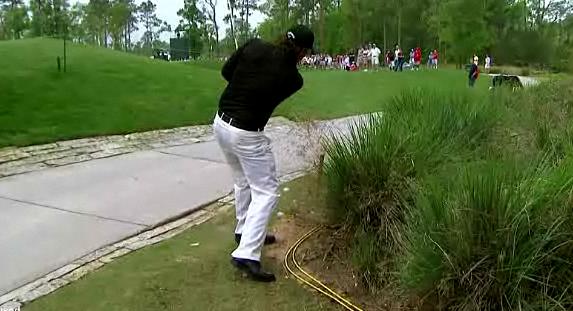
During play on Hole Ten, on the second day of the 2010 Shell Houston Open of the PGA Tour, Phil Mickelson's tee shot came to rest on the edge of a lateral water hazard, just inside it, next to some television cables.
The cables, which could be easily moved, are movable obstructions, so Phil proceeded to move them following the dictates of Rule 24-1, which states that “if the ball does not lie in or upon the obstruction [the cables], the obstruction may be removed. If the ball moves, it must be replaced, and there is no penalty so long as the movement of the ball is directly attributable to the act of moving the obstruction.” .
We must remember that, even if the ball lies within the lateral water hazard, the player can take relief from movable obstructions without penalty, but not from immovable obstructions, for which there is no relief without penalty when the ball lies in a water hazard.
Once he was relieved of the cables, the man known as the "Golden Lefty" decided that he could play the ball without needing to take relief under Rule 26-1 of water obstacles, even if it meant playing the ball right-handed.
With a magnificent right-handed swing, Phil managed to hit his ball, but unfortunately, it bounced off his leg and came to rest again in the side water hazard. However, Phil didn't just hit his ball; in doing so, he also struck a second ball that was hidden among the plants.
In addition to the understandable bewilderment of the player who saw two balls fly out of the brush, Phil had to add a penalty stroke to his score for the hole for violating Rule 19-2. This Rule states that “if a player’s ball is accidentally deflected or stopped by himself, his partner, or any of his caddies or equipment, the player incurs a penalty stroke” and “the ball must be played as it lies.” .
Regarding the hidden ball that he also hit, Phil was informed by one of the trial umpires of the content of Decision 15/2:
15/2 Player who, when playing his ball, dislodges a hidden ball
A player, while playing his ball in the rough, simultaneously strikes an old, abandoned ball that was hidden beneath his ball. Since he struck the hidden ball, did he play the wrong ball?
R No. The player played a stroke with his own ball, not with the hidden ball. Since he did not play a stroke with the hidden ball, Rule 15-3 does not apply. The player must play his ball as it lies.
Although Phil didn't have to add any more penalty strokes to his score for this reason, some additional penalty strokes did have to be counted. Since his ball again came to rest within the lateral water hazard, and this time in an unplayable situation, Phil had to proceed under Rule 26-2a, which tells us how to proceed when we play a ball from within a water hazard and are unable to get it out of the hazard (or, if we get it out, send it into another water hazard).
Indeed, of the numerous options the player has under this Rule, Phil finally chose to drop a ball under the penalty of one stroke within the two-club area, without going near the hole, from the point where the ball crossed the margin of the obstacle after hitting his leg, i.e., the point where the ball crossed the margin of the lateral water obstacle for the last time, as set out in Rule 26-2a(ii).
In the end, Phil left the 10th hole with a triple bogey and a curious Rules problem that is more reminiscent of a hypothetical situation for a referee exam than a real event in a PGA Tour tournament.
To avoid confusion with the Rules, visit the Rules Section from the website. Also suitable for left-handed users.