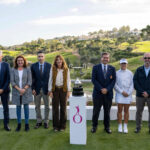
The Golf Forum opened its doors and met for the first time at the Parador del Golf in Torremolinos, promoted by the Royal Andalusian Golf Federation, with the attendance of club managers, designers, promoters, tourism experts and specialized journalists, not only from the area but also from Madrid and Barcelona, who traveled especially to attend the meeting.
Carlos Gil, the group's coordinator, welcomed the attendees, and Miguel Nieto acted as moderator and spokesperson: “The Golf Forum is an open platform for study and analysis, even for debate, created with the intention of lasting and continuing. We want to work to change the distorted image that many people have of golf, and we are a working group that does not intend to act as a lobby, but rather to welcome all those who wish to support us, as well as our detractors. We want to present a clear picture of the current state of golf, with its successes and failures. We will accept justified criticism and will try to refute unjustified criticism with factual arguments and data that explain to the public the benefits that golf provides.”.
Next, José Emilio Guerrero, Professor at the University of Córdoba, José Canales and Salvador Álvarez Escobar spoke about the “Technology of the design and conservation of golf courses”.
Salvador Álvarez Escobar, “Varo”, manager of Guadalhorce, acknowledged that: “Twelve years ago I used to say I was going to play tennis, because I was embarrassed to say I was going to play golf. Things have changed a lot, and golf is no longer an elitist sport; it's relatively inexpensive, and now everyone plays. But this wonderful sport is being blamed for a problem that isn't ours, but rather a problem with the construction industry. And how is all this going to be regulated? The Golf Forum was created with the aim of providing assistance, and it's made up of people with extensive experience in this sector, so we would like the relevant authorities to consult with us and take our advice.”.
José Canales, a golf course designer, recalled that “the golf ball is what has driven the evolution of the design world. When building a course, the Thumb rules should be applied, such as designing the course clockwise, never starting with a par 3 but rather with an easy hole, gradually increasing the difficulty of the course, avoiding consecutive par 3s and 5s, and minimizing blind shots, but these are often overlooked by designers.”.
Ángel de la Riva, President of the Royal Andalusian Golf Federation, recounted that when he first assumed the presidency there were only “four 18-hole courses and one 9-hole course in Pineda. Now, there are 96 member clubs and some 150 projects, although some will fall by the wayside.” He suggested that “all four regional ministries should join forces to defend and support golf: not only Tourism, Commerce and Sport, Environment and Public Works, but also Economy and Finance, because golf generates significant revenue for Andalusia and many benefits for the region.”.
José María Zamora, Director of Tournaments for the PGA European Tour, stated that “Andalusia is an important destination in world golf and needs, like many other destinations (Dubai, Ireland, Scotland…), to host one or two high-level international tournaments. This year our region will have two: the Valle Romano Open de Andalucía and the Volvo Masters. Tournaments like these help position the region on the world golf map and, through Tour Productions, bring the image of the area to millions of homes around the world with approximately 400 hours of weekly television broadcasts.”.
Antonio Muñoz, Director General of Tourism Planning and Development, began by saying that “golf is very important for the Andalusian economy and can and should continue to grow.” He also indicated the “advisability of creating a network of golf courses of tourist interest,” and acknowledged that “golf is a tourism product that enriches and diversifies the offerings, contributing to reducing the seasonality of demand.” He provided data such as “the 915 million euros generated by the Volvo Masters in the last edition, 14.5% more than in 2005.’.
Next, Manuel Oñate, Head of the Environmental Protection Service, and Manuel Burraco, Undersecretary General of Territorial Planning and Urban Development, offered the vision of their respective departments.
Champion Miguel Ángel Jiménez, who was scheduled to close the round of presentations, not only fulfilled his duty but also attended the Forum meeting from early morning, taking notes throughout the session. “I’m leaving here a little worried. I thought we all started from the same root, but I see that each branch is pulling in a different direction,” he remarked after hearing the perspectives of the last two speakers.
Jiménez continued, “We must offer controlled quality. We have a lot of competition, and if we're not careful, we'll be left high and dry. I started playing in Dubai in 1990, and from there to Abu Dhabi there was just a tiny two-lane road. Today, there's a magnificent seven-lane highway, and those countries have become two of the best golfing destinations in the world. The best part is that we can continue to export our region to the world and show that we're doing things right. We have to keep golf going, but with golf done right, supporting good projects and good ideas, and knowing that we're not doing ourselves any favors by doing things poorly.”.
GOLF-RELATED DATA
– Golf revenues increase by an average of 30 percent annually.
– A field needs about 500,000 cubic meters of water per year.
– Over the last ten years, farms have optimized their irrigation water consumption by 40 percent. And of all of them, 50 percent use recycled wastewater.
-Recycled water costs half as much as drinking water.
– Of Andalusia's total water consumption of 5,426 Hm3, 77 percent is for irrigation. Golf courses consume 9 Hm3.
– 43 percent of golfers travel more than nine times a year to play. During the low tourist season, they stay in hotels for between two and four nights.
– Golf generates approximately 2.375 billion euros per year for our country (2005 data).
– Main countries of origin: United Kingdom, Germany, Sweden and France.
– They generate between 8 and 12 million per hectare of profits compared to 500,000 pesetas for one agricultural hectare.
– A golf tourist spends 50 percent more than a typical tourist: 77 euros compared to 49 (2004 data). They are highly educated and, therefore, demanding, sensitive to, and require respect for the environment. They are highly loyal tourists and return to the same destination, provided they are satisfied with the value for money.
– Andalusia is heading towards one hundred golf courses and has already become the largest golfing emporium in Europe, after the United Kingdom.