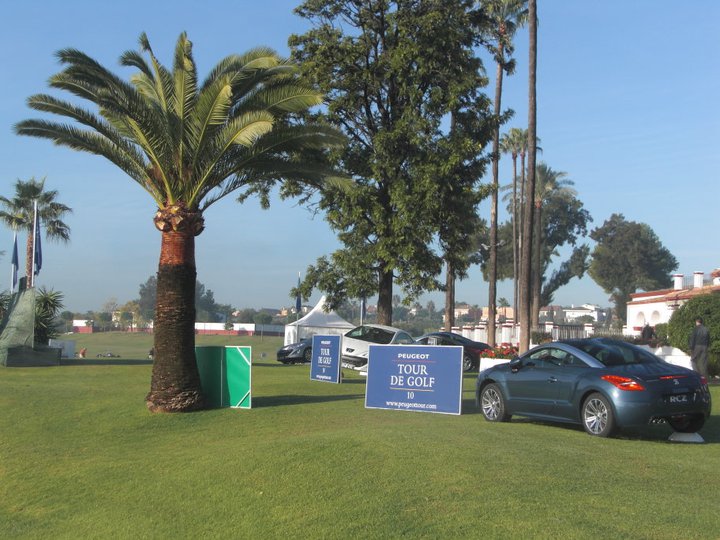
The Peugeot Tour final in Zaudín is played in a complex format. It essentially consists of two competitions in one. The professionals compete in an individual competition over four 18-hole rounds and, simultaneously, compete for the first 36 holes in a Four Ball competition paired with an amateur player.
This means that the professionals are playing an individual competition and a Four Ball competition, while the amateurs only play a Four Ball competition, in which the best result of the team formed by the professional and the amateur on each hole will count.
It sounds simple enough, but for the purposes of the Rules it's more complex than it first appears. It's so complex that Decision 31/1 was issued in 2008 to address these types of simultaneous competitions.
31/1 Examples of decisions when playing four balls simultaneously Stroke Play and individual competition.
When competitors take part in simultaneous stroke competitions, the Rules apply, where possible, only to the competition concerned. Where it is not possible to separate the competitions, the four-ball competition takes precedence. The exception relates to Rule 8-1 (advice), as two partners cannot exchange advice if both are playing in the individual competition; if only one of them is playing in the individual competition, they may exchange advice.
A and B are partners in a four-ball stroke play competition and are simultaneously playing an individual stroke play competition; the following are examples of the application of the Rules in such a format:
(1) B moves A's ball without the Rules permitting it. In a four-ball competition, A incurs a one-stroke penalty (Rule 18-2a) but not a penalty in the individual competition. B incurs no penalty in either competition.
(2) On the third hole it is discovered that B started his round with 15 clubs. In a four-ball competition, side AB incurs a total penalty of four strokes (two strokes on each of the first two holes) but A does not incur a penalty in the individual competition. B incurs a total penalty of four strokes in the individual competition.
(3) During the round, B makes a stroke on a non-conforming ball. In the four-ball competition, side AB is disqualified (Rules 5-1 and 31-7a) but A does not incur a penalty in the individual competition. B is disqualified from the individual competition.
Many other situations besides those mentioned in the decision can be found. For example, what happens if the professional, while playing his ball, hits the amateur's bag?
The answer differs for each competition. In doubles, the professional's ball will have been deflected by their partner's equipment, in which case Rule 19-2 applies, and the professional incurs a one-stroke penalty and must play their ball as it lies. However, in singles, the professional has no partner, so their ball will have been deflected by a fellow competitor's bag, in which case Rule 19-4 applies, which refers us to Rule 19-1. According to this Rule, it would be considered an eventuality of play, so the professional incurs no penalty and their ball is played as it lies.
What happens if the amateur finishes a putt and, before his professional sinks it, smooths the edge of the hole with his finger with the clear objective of taking care of the course?
The answer can be found in Decision 1-2/3.5:
1-2/3.5 The player repairs the hole after sinking but before his opponent, fellow competitor or partner does.
Q After sinking a hole, a player notices that the edge of the hole is chipped. He flattens the chipped edge with his hand and smooths it. Does the player incur a penalty under Rule 1-2 if his opponent, fellow competitor, or partner has not sinked a hole?
R If the player smoothed the edge of the hole as a courtesy to players in later groups, or to look after the course, he did not breach Rule 1-2. However, if the player's principal purpose in smoothing the edge of the hole was to influence the movement of his opponent's, fellow competitor's, or partner's ball, he breached Rule 1-2.
Since the player had made a hole-in, there is no penalty under Rule 16-1a or Rule 13-2.
In a four-ball competition, if the player's partner has not completed the play of the hole, the partner would be penalized for a breach of Rule 16-1a (see Definition of “Partner”). (Revised)
According to this ruling, since the amateur player's purpose was to look after the course, he incurs no penalty. The professional also incurs no penalty in his individual competition, in which the amateur player has no involvement. However, in Four Ball competition, the professional would incur a two-stroke penalty for a breach of Rule 16-1a, when his partner touched his line of putt, which includes the edge of the hole.
Imagining different Rules scenarios in this format is either a fun exercise or a diabolical brain teaser, depending on how you look at it. If you'd like to imagine even more possible scenarios, you might find it helpful to visit the [link/website/etc.]. Rules Section from the website.