The slow but steady expansion of golf across Spain during the first three decades of the 20th century, and the abrupt halt caused by the traumatic Civil War, formed the general outline of the story in the previous issue. The incorporation of Seville into the national golf scene and the institutionalization of the Spanish Amateur Championship, for both men and women, were the next steps in the consolidation of golf in our country. All this while, tentatively but equally unstoppably, the Spanish Professional Open was taking shape.
Sevilla takes action
A city with the importance and tradition of Seville could not remain on the sidelines of the growing trend of hitting a white ball with clubs amidst incomparable beauty. Thus, in 1940, at the Cortijo de Pineda, three kilometers from the Andalusian city, the Club Pineda de Sevilla was established thanks to an agreement between members of the defunct 'Real Club Tablada' and 'Real Sociedad de Carreras de Caballo' societies, who joined forces to begin construction of the golf course the following year, which at that time consisted of only 9 holes.
Near Barcelona, exactly 32 kilometers away, practically on the Mediterranean coast, the idea began to take root around that time to add another golf course to the list of Spanish courses, this one located in the town of San Andrés de Llavaneras. Although the negotiations weren't overly difficult, the official opening of Llavaneras was postponed until 1945. This brought the total to a dozen facilities—there could have been thirteen at that time, in the mid-1940s—although one more of the terrible consequences of the Spanish Civil War of 1936-39 was the destruction of the Royal Spanish Equestrian Society Country Club, located on the right bank of the Manzanares River.
At this point, it was necessary to organize, to contribute jointly to the development of golf in Spain, to continuously hold national championships so that they would gradually acquire greater prestige, to make collective decisions so that this sport would expand to all corners of the Spanish geography in the image and likeness of what was happening in some countries around us (England, Ireland, France, Sweden…) and on the other side of the oceans (United States, Japan…), where golf was beginning to take hold with unusual force among its population.
The shared desire for improvement led several clubs to form the Spanish Golf Clubs Federation. This initiative, launched in October 1932, was abruptly halted by the devastating impact of the Civil War on all activities. The formal paperwork was completed at the private residence of Mr. Luis de Olabarri, located in Las Arenas, Getxo, at a meeting attended by representatives from the Club de Campo (Pedro Cabeza de Vaca), Club Puerta de Hierro (Pedro Gandarias), Club de Lasarte (Santiago Ugarte), Club de Pedreña (Marcelino Botín), Club de Neguri (Luis de Olabarri), and Club de Sevilla (Javier de Arana).
The registered office of that Federation of Golf Clubs of Spain was located at the Puerta de Hierro Club, in Madrid, although there was the curious exception that, between the months of June and October, the organization resided either in Pedreña, or in Lasarte, or in Neguri, as designated at each time by the Secretary General depending on the summer needs of the time.
Luis de Arana, first president
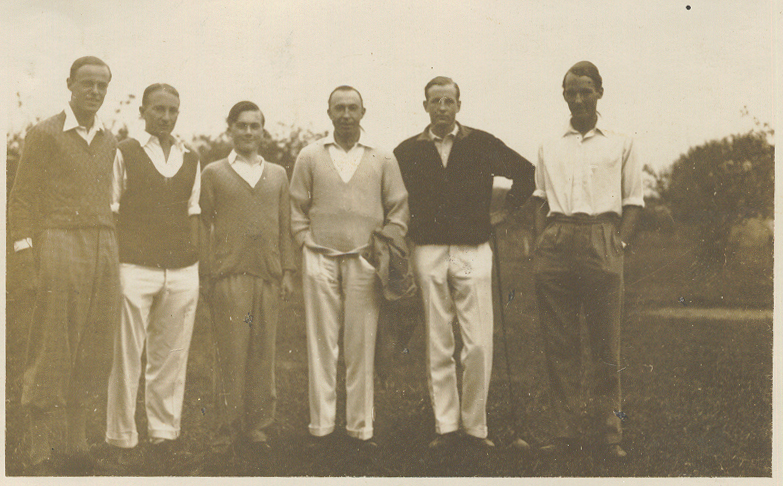
Luis de Arana, father of a great dynasty of golf players, who reaped a very significant number of titles during those years, was appointed the first president of the Spanish Golf Federation – the organization that took over the legal mantle from the aforementioned Federation of Golf Clubs – although his responsibility was limited to two years, precisely those between 1934 and 1936.
On May 31, 1939, Francisco Carvajal y Xifré, Count of Fontanar, was appointed as the head of Spanish golf by direct order of the then National Sports Council. His extensive term lasted 11 years before he was succeeded in April 1950 by Luis de Urquijo y Landecho, Marquis of Bolarque, who served as President of the Spanish Golf Federation until April 1959, when he was appointed Spanish ambassador to West Germany.
By then, the Spanish Amateur Championships, for both men and women, had happily become a regular occurrence, the difficulties that had at times prevented other competitions from taking place now a thing of the past. The aim was to fulfill the need to recognize the best amateur player in Spain, and so in 1940 the men's category was introduced to the competition calendar. The women's category was postponed until the following year—the reason is not recorded in the archives, although low participation could be the cause—both held at the Terramar facilities.
It is true that at that time the Spanish International Amateur Championship and the Puerta de Hierro National Cup were already being contested. However, the former allowed the participation of foreigners, whether or not they were residents of Spain, while the latter had a philosophy that focused on clubs above the individual, so that the following year's edition was held—as it is today—at the club to which the current season's winner belonged.
José Vallejo and Ana López Dóriga, who had previously won three Spanish International Amateur Championships in the 1920s, had the honor of being the first to inscribe their names in the list of winners of these competitions – one in 1940 and the other in 1941 – starting a long list that has since included the great figures of Spanish golf.
Simultaneously, the Spanish International Open Championship was held, a competition reserved for the few professionals of the time. Although its first edition took place in 1912, this tournament did not gain real traction until after the Spanish Civil War. To fill the entry list, certain amateur players were allowed to participate, which led to the emergence of the Marquis of Sobroso, Luis Ignacio Arana, and others—precursors to players of the caliber of Iván Maura, an amateur who rubbed shoulders with those first truly top-level professionals (Marcelino Morcillo, Carlos Celles, etc.) who dominated elite Spanish golf before the incomparable Sebastián and Ángel Miguel, two brothers forever etched in our memories.