By the mid-1950s, it was quite difficult to find individuals with a golfing career spanning several decades. At that time, all attention was focused on the increasingly spectacular feats of the Miguel brothers – Ángel and Sebastián – professional players of immense talent who were able to win in Portugal, France, and Spain after overcoming the competition of the best players of the era. This was more than enough reason for the Spanish Golf Federation, with its President the Marquis of Bolarque at the helm, to pay them a warm tribute at Puerta de Hierro in 1955.
At a lower rung, one could find people of much more modest means who also dedicated their lives to golf. This was the era when caddies formed a large group, always hoping to advance and become instructors, earning extra money by teaching golf to the wealthier classes of our country.
Genuine representatives
Among them all, three stand out, genuine representatives of a group that lived permanently on golf courses, from sunrise to sunset, helping anyone who asked, even correcting the swing of the most seasoned politicians and bankers.
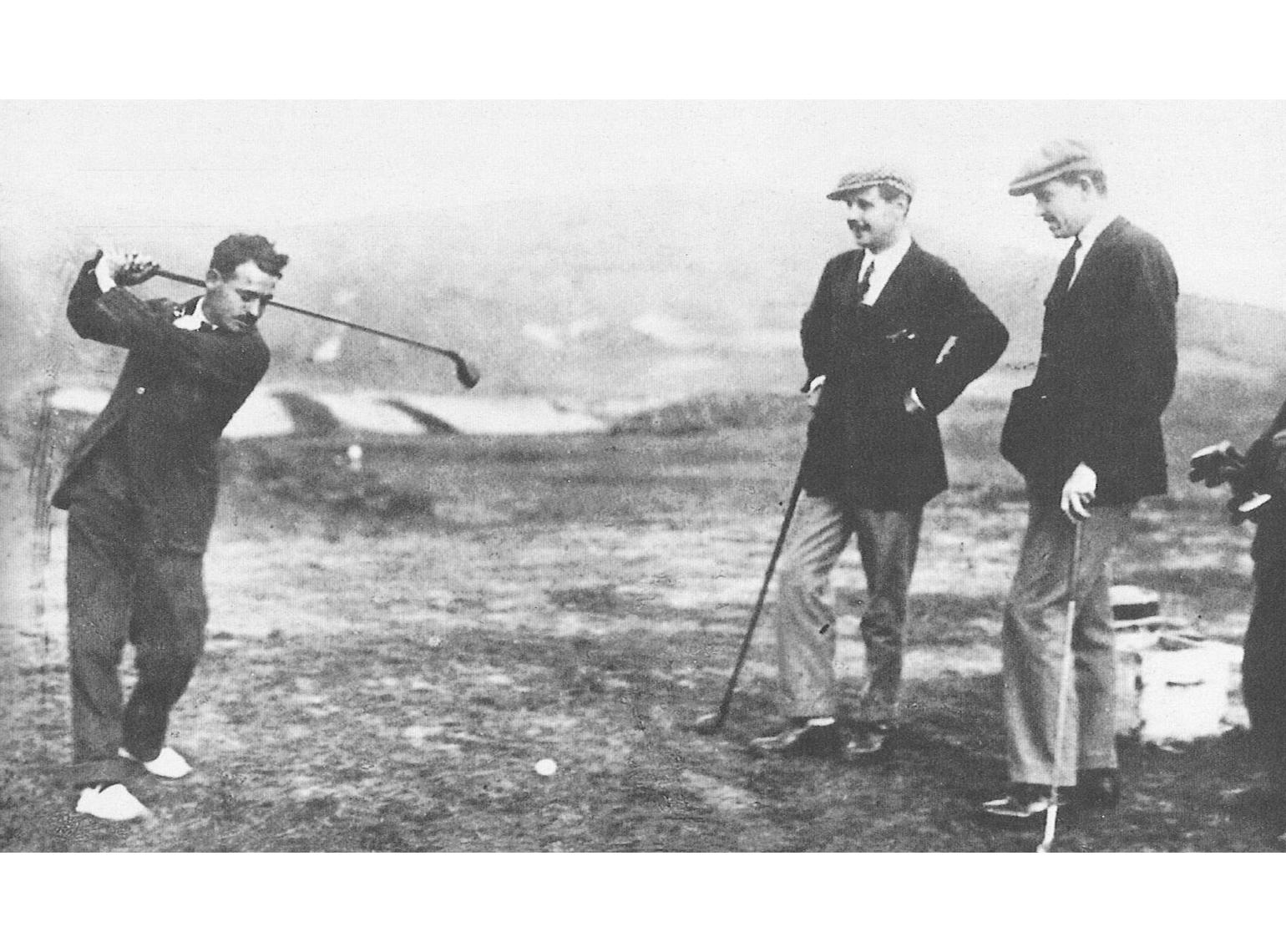
Emilio Cayarga was one of them. In 1905, when the Madrid Polo Golf Club had 9 holes, located on the grounds of the Castellana racetrack, precisely where the Monument to the Constitution and the Museum of Natural Sciences stand today, he accompanied his father, who was in charge of the club's plumbing. Young Emilio took the opportunity to try his luck with a club and ball, an experience so positive that he soon abandoned his rags and soldering iron to pick up a bag of clubs and offer his services as a caddie, earning the affectionate nickname 'Tin Can'.
During that time, he met Ángel de la Torre and Joaquín Bernardino, a trio whose dedication to golf was unmatched. Ángel de la Torre, undoubtedly the most audacious and enterprising of the three, quickly began to see the world thanks to golf. It was a different era in the early 20th century, and Ángel de la Torre became a professional caddie at the age of 14 in Saint-Jean-de-Luz, sent by the Count of Cimera, where he met Arnold Massy, one of the great players of the time.
After the outbreak of World War I, Ángel de la Torre returned to Madrid, where he obtained a position at the Madrid Polo Golf Club to replace the golf instructor, who, due to his French nationality, was required to go to the front lines. Years later, in 1925, Ángel de la Torre decisively packed his bags and headed for the United States.
There, in the Mecca of so many dreams, the former caddie became a highly renowned teacher thanks, among other things, to the sensational record accumulated before leaving, no less than 5 victories in the Spanish International Open Championship – the current Spanish Open – a milestone that he further enhanced in 1935, when he inscribed his name for the sixth time on the list of winners, making him the most outstanding in history to this day.
Settled on Long Island, Ángel de la Torre earned between $8,000 and $10,000 annually in the 1920s and 30s, a veritable fortune that mitigated his public longing for Spain, to which he returned whenever he could.
With less adventurous aspirations, Joaquín Bernardino also spent half his life teaching golf in Madrid after starting out as a caddie. The Count of Cimera, the Marquis of Urquijo, Joaquín Santos Suárez, Raimundo Fernández Villaverde, the Count of Martorell, the Mrs. de Marsans – for women also played golf in those early decades of the 20th century – and many others received advice from Bernardino and 'Hojalata', who would eventually end up in Pedreña.
Medals for Sporting Merit
Once again fully immersed in the 1950s, other figures were making decisive contributions to the development of golf. This was the case, for example, of Luis Ignacio Arana, who, along with the ubiquitous Ángel Miguel, received the Medal of Sporting Merit from the National Sports Delegation. His father, Luis Arana, was the leading figure of an undeniably talented golfing dynasty, among whom Luis Ignacio stood out. He liked to recount that, after doing the necessary calculations, he had traveled more than 60,000 kilometers "chasing and abusing the golf ball.".
Almost always accompanied by his brother Javier –another prominent member of the Arana saga–, Luis Ignacio accumulated title after title since winning the Vizcaya Championship at the age of 16, all of this combined, later in life, with his role as a teacher of Descriptive Geometry.
Having received the Medal of Sporting Merit, Ángel Miguel, who also began his career as a caddie, was determined to prove that the award was well-deserved. Indeed, his participation in the 1955 Morocco Open and Algiers Open resulted in victories in both tournaments, sharing in the sweet taste of success with another highly regarded player of the time, Carlos Celles, who finished fifth in both competitions.
All that triumph, all that success, and all that praise brought Ángel Miguel a sweet reward: starring alongside his brother Sebastián in an advertisement for Mallerich clothing. In the ad, they flanked a beautiful woman who took them by the arm. "Beauty and sport united in the choice of the ideal garment: Mallerich," read the slogan of the advertisement, which featured Carmen Sevilla, the celebrated actress, prominently. She didn't hesitate for a moment to lend her image to promote those beautiful clothes... and, incidentally, Spanish golf.
The sport of clubs and balls, in our country, had a long way to go, always with the reference of what was happening in the United States, where golf courses were multiplying like mushrooms and where even the President of the Government, Eisenhower, was a true devotee, to the point that a group of friends built him one of the most curious Pitch & Putt courses in history, located at his residence of Camp David, in the mountains of Maryland, where he spent the weekends when his obligations allowed him to.
There at Camp David, the residence was surrounded by a deep forest, but in front of the house stretched a green meadow about 130 meters wide and long—a small area for a proper golf hole. In return, Robert Trent Jones, the famous architect who would later design Sotogrande in the 1960s, provided him with four distinct holes—using four strategically placed tees—and a single green! This revolutionary idea would later be imitated in other prestigious locations.