Barcelona, at the end of 1954, was a hive of activity. It is true that there were already several golf courses in the surrounding area – Sant Cugat, Terramar, Llavaneras – but the imminent opening of new facilities just a few kilometers from the city center, next to the beach, near the airport, was a major event that no one wanted to miss, whether they were a golf enthusiast or not.
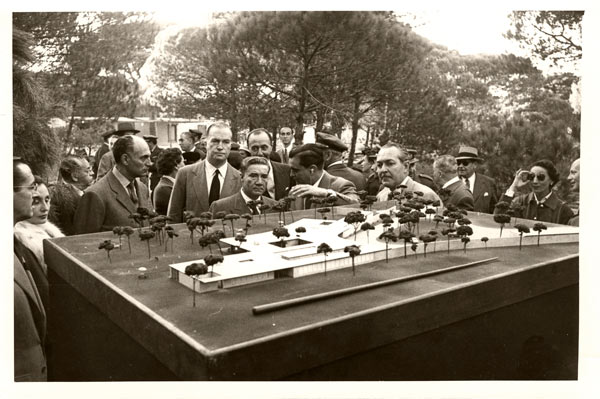
It was on October 26, 1954, when the Minister of the Air Force – not surprisingly, since most of the land where it was located belonged to this institution – laid the first stone of the El Prat Clubhouse, a society destined to become an essential reference point for Spanish and European golf due to the commitment shown from the very beginning by its managers.
The event was also attended by the main political authorities of Barcelona and El Prat de Llobregat, as well as the Regional Delegate of the Spanish Golf Federation, the Club's Board of Directors, and a large number of members eager to hit the ball on the velvety greens of this new course. To further enhance the occasion, the ceremony was blessed by the parish priest of El Prat, who, along with all those present, toured the 10 fairways and 11 greens that were already sown, suggesting that play could begin as early as the spring of 1955.
The overall feeling was one of deep satisfaction. The course designed by the prestigious Javier Arana more than lived up to expectations, and as for the Clubhouse, everything was in place to ensure that the facilities would be a dream come true for all its members. Plans were underway for the construction of a magnificent swimming pool, which would perfectly complement the experience for those who also wanted to take a dip in the sea right on the beach.
The course itself ran through pine trees, on sandy terrain, in the style of Chiberta, with two holes parallel to the sea, a landscape that could also be enjoyed from the Clubhouse, strategically located next to the 9th, 18th and 12th greens and the 1st and 10th tees.
The managers of El Prat were particularly pleased with the modern irrigation system installed throughout the field, based on three artesian wells with their respective pumps that were capable of pumping 100,000 liters of water per hour at five atmospheres of pressure, which fed through pipes portable sprinklers that sprayed the liquid element in the form of rain more than 30 meters away.
At that moment, everyone was aware of the significance of this new beginning. The construction of the Clubhouse—a project by the architects Terradas and Coderch de Sentmenat—and the completion of a few holes still remained, but the tremendous enthusiasm evident on the faces of everyone present suggested that El Prat was going to be an extraordinary success. And so it was, indeed, it soon became so.
Sebastián Miguel wins the Spanish Open
This important social event diverted attention for several weeks from purely sporting matters that also took place during the last third of 1954. This was the case, for example, with the Spanish Open, which Sebastián Miguel brilliantly won against the most famous European aces. That feat took place at Puerta de Hierro, with more than 3,000 people following the players' progress, a considerable number for the time.
Sebastian, however, didn't have it easy, especially since the Englishman Faulkner, winner of the title in the two previous editions, had traveled to Madrid; as had his compatriots Dai Rees and Eric Brown, winner of the Portuguese Open the previous year; the Frenchmen François Saubaber and Jean Garastialde; the Italians Alfonso Angelini, Ugo Grappasonni and Aldo Casera; the Belgian Flory Van Donck… as well as, curiously enough, the American Fergus Anderson, an amateur golfer who was a world motorcycle champion!!
Such a star-studded lineup generated fear among more than one Spanish fan, although Sebastián Miguel dispelled that feeling from the very first moment thanks to a spectacular game that in the first round resulted in a score of 62 strokes!! The general astonishment gave way to all kinds of praise as the competition progressed, with a Sebastián touched by the wand of the gods who did nothing but accumulate birdie after birdie before being proclaimed champion with a 6-stroke advantage over… his brother Ángel, a cinematic result that helped to boost the sport of golf at that time.
Young promise with a long career ahead
At the end of 1954, attention was also focused on the celebration of the Spanish Junior Championship at the Real Golf Club de Zarauz, which had the participation of ten boys and four girls, certainly far from the massive entries that characterize the current competition that designates the best junior player in our country!!
In any case, everyone gave their best in a competition that at that time was played over 18 holes, as prescribed by the regulations, with both categories teeing off from the ladies' tees. The small number of participants in the women's championship allows us to list them in full: Begoña de Artola, Maribel Girod, Chanito de Abaitúa, and Ana María de Leva. Begoña, with 53 strokes for each of the nine holes, took the prize, followed 10 strokes behind by Maribel Girod.
Meanwhile, the men's tournament was hard-fought, but a young man from San Sebastián, who was already considered a future star by experts, took charge of blowing up the competition in the first part of the course.
Luis Álvarez de Bohorques, the young man from San Sebastián, effectively sealed the championship by posting a 37 in the first nine holes, a superb score that rendered Manuel Cardenal de Abaitúa's efforts futile. Cardenal finished second, three strokes behind the new champion, despite overtaking him (43 to Luis's 45) in the final nine holes. Ricardo Muguruza, Álvaro Arana, José Ignacio de Artola, Víctor de Chavarri, Jaime de Soto, José de Leva, and others also faced the inherent challenges of the Zarauz course.
“This kid is going to do great things in golf,” some said, with a sense of foreboding, referring to Luis Álvarez de Bohorques, unaware at the time that their hasty judgments would come true. And indeed, Luis Álvarez de Bohorques continued to display a precise and confident style of golf for the following years, which led him directly to the national golf teams, representing Spain in numerous international competitions.
His resume also included the 1963 Puerta de Hierro National Cup and the 1965 Spanish International, as well as two holes-in-one, completing a record of service that also extended to the organizational side from very early on. Luis Álvarez de Bohorques joined the Spanish Golf Federation in 1966, becoming Vice President in 1971, and specifically directing the Amateur Technical Committee.
A member of the Standing Committee and the Administrative Committee, and the creator of the Madrid Open for Professionals, he was appointed Secretary General of the RFEG (Royal Spanish Golf Federation) in 1980, a prominent position from which he has energetically promoted golf in Spain for the last 25 years. “This guy is going to do great things in golf.” This world certainly has its share of soothsayers.