In 1954, we noted in the previous issue the growing prominence of our most outstanding players, capable of shining brightly both within our borders and beyond. Indeed, Spanish golf was slowly gaining prestige abroad thanks to the efforts of a few individuals increasingly willing to test their skills and golfing knowledge far from the courses where they honed their game daily.
Those were years when the precarious economic conditions of the professionals and the Spanish Golf Federation itself made it impossible to cover most of the travel expenses, so receiving invitations was almost essential for our representatives to gain recognition. This happened back in 1954 with trips to Egypt, Germany, the United States, Canada… distant destinations where Spanish professionals responded favorably to the kind invitations, generating praise and positive feedback that fueled the process by encouraging further participation.
New experiences
For the first time, the Spanish were confronted with a style of play and championship organization that was light years away from what they were used to. Participating in competitions like the Canada Cup or the Tam O'Shanter in Chicago—considered at the time to be an Individual World Championship—meant facing dozens and dozens of world-renowned players, followed, as in the case of the Chicago tournament, by more than forty thousand people who didn't hesitate to pay 3 or 4 dollars at the time to watch the matches, which were already being broadcast on television to dozens of countries around the world.
The second edition of the Canada Cup, the World Pairs Championship, was held at the Golf Club Laval sur le Lac in Montreal. Organizers spared no expense, providing each invited nation's designated players with a $500 stipend for personal expenses, in addition to travel and hotel accommodations. This stipend also covered the cost of caddies during the competition. In total, over $100,000 was allocated to ensure that everything—and it did—ran perfectly.
The Spanish Golf Federation selected Carlos Celles and Sebastián Miguel, known in Spanish golf circles as 'Carlines' and 'Duque' respectively, to represent Spain. Accompanied at all times by the Spanish ambassador to Canada, Mariano Iturralde, and his brother Daniel, the pair of Spanish golfers prepared to face one of the biggest tests of their respective sporting careers.
Electrifying premiere
As fate would have it, Sebastián Miguel—who was practically playing his first match outside of Spain—had the honor of starting the competition. When he stood on the tee, surrounded by thousands of spectators, and heard the customary team introductions over the loudspeakers, he thought—as he later recounted—that it was all beyond his control, and only when he heard the resounding ovation that rewarded his perfect drive did his nerves begin to calm down.
Carlos Celles then made a start that was in no way inferior to that of his partner, which contributed to both of them being recognized with enormous sympathy later on, especially because they were the youngest pair in the competition.
In the first round, where they both shot 72, they played alongside Englishmen Harry Weetman and Peter Allis, the latter one of the hardest hitters in the world, who completed the course in 69 and 74 strokes, respectively. Then, in the second round, they shared the experience with Scots Eric Brown and Tom Haliburton (the Spaniards shot 71 and 73; the Scots 69 and 71), while in the third and final round they played with South Africans Bobby Locke and Bert Thomas.
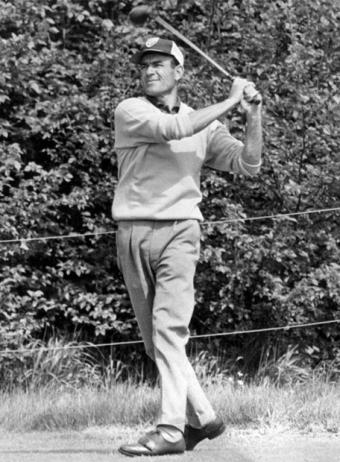
Sebastián Miguel, increasingly confident, finished in twelfth place in the individual ranking, quite an achievement considering that it was his first important experience outside our borders and that there were players of the highest world relevance such as Sam Snead, Eric Brown, Francois Saubaber, Peter Allis, Jules Hout…, all of them behind him in the final ranking.
Carlos Celles, for his part, suffered an unfortunate eye swelling that significantly affected him in the last 36 holes. Medical treatment offered no relief, preventing Spain, which ultimately finished thirteenth, from improving upon its already respectable performance.
Angel Miguel, at the unofficial World Cup
Spain's participation in the Tam O'Shanter in Chicago – the aforementioned unofficial world championship – was also marred by incidents. Ángel Miguel, the golfer chosen to represent Spain, as in the previous edition, was involved in an incident that hampered his performance on the course from the moment he hit a spectator in the face with his ball on the 11th hole, during the second round.
The tee was 150 meters from the hole, and Ángel Miguel, after a moment's hesitation, opted for a 6-iron, taking his swing calmly. The ball, clean, nevertheless overshot the green, striking the spectator in the face. She fainted, bleeding profusely from the nose.
After receiving the necessary medical attention, Ángel Miguel managed to make par on that hole, but from then on his game was imprecise, finishing that round with 80 strokes that relegated him to the bottom of the leaderboard, even though his game improved considerably in the third and fourth rounds (74 and 69 strokes). “I haven’t been able to stop thinking about the lady,” he repeated nervously after finishing that eventful second round.
Marcelino Morcillo, to Germany
Another prestigious Spanish representative, Marcelino Morcillo, took part in the German Professional Championship, which in 1954 joined the ranks of top-tier European golf tournaments. Bobby Locke and Dai Rees led the standings at the end of the four days of competition, necessitating a playoff to determine the winner, which ultimately tipped the scales in favor of Locke. Marcelino Morcillo, true to form, demonstrated undeniable improvisational skills. Indeed, the days leading up to the championship were marked by a continuous downpour that severely restricted practice, preventing Marcelino from familiarizing himself with the course beyond a hurried, partial round under an umbrella.
His first two rounds were described as weak, undoubtedly due to the circumstances described above, although in the last 36 holes he managed to go under par twice, an effort rewarded with 200 marks of the time.
The initial success of Spanish professionals abroad encouraged the Spanish Federation to increase the importance of the Spanish Open. To this end, in collaboration with the Portuguese Federation, a commendable effort was made to ensure that both the Spanish Open and the Portuguese Open, held consecutively, secured a prominent place on the continental calendar.
The competition, which was to be held at the Puerta de Hierro facilities, had the confirmed presence of prestigious players such as the Englishmen Max Faulkner, Dai Rees, Eric Brown, the Belgian Flory van Donck, the Italian Ugo Grappasonni, the Egyptian Hassanein…, even the French amateur Henri de Lamaze, the best in all of Europe, whose adventures in this Spanish Open we will give a good account of in future stories from yesterday.