
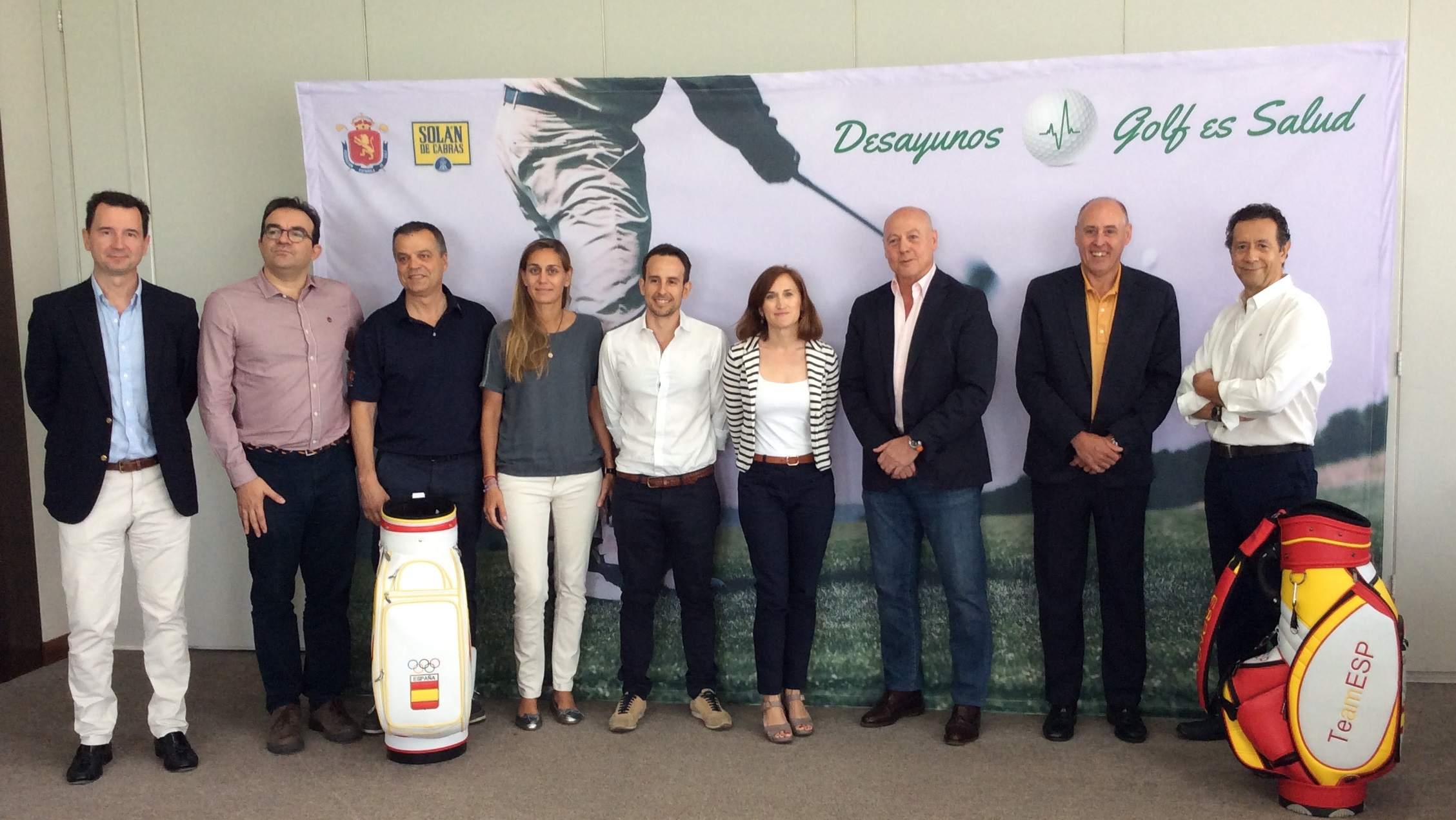
.Los profesionales alertaron de algunos males de nuestra sociedad: falta de tiempo para cocinar, desconocimiento a la hora de hacer la compra,…
.“Comiendo mejor no vas a ser más feliz ‘per se’, pero sí vas a vivir más y mejor”
La Real Federación Española de Golf ha promovido una nueva jornada de los Desayunos Golf es Salud, una mesa redonda compuesta por especialistas médicos de prestigio en la que se debate sobre los efectos beneficiosos relacionados con la salud que conlleva la práctica del golf. Esta vez era turno para los nutricionistas y endocrinos, que llamaron la atención sobre la importancia de asentar en la población unos correctos hábitos alimentarios y de volver a la dieta mediterránea.
With Xavier Guibelalde, Marketing Director of the RFEG, and Guillermo Salmerón, a journalist specializing in golf, as masters of ceremonies, the session began, which once again had its starting point in the introduction of Dr. José Antonio García Donaire (see outline of his curriculum and of the rest of the participants below).
The renowned nephrologist set the stage for those present by referencing the study by Dr. Andrew Murray, who led the University of Edinburgh research that concluded playing golf can extend a person's life by almost five years. He added that poor nutrition, combined with a sedentary lifestyle, is a problem that must be addressed. "We need to teach people how to exercise, how to do exercise that's good for them, but also how to eat properly," he pointed out.
“We have abandoned the Mediterranean diet”
Getting down to brass tacks, the nutritionists began to dissect the current situation. Jesús Román revealed that “the statistics are reasonably good, but in reality, we see that there are people who take care of themselves and eat well, and others who have completely abandoned the Mediterranean diet. We have clearly abandoned this healthy diet, and it's due to several factors: there's no time or desire to cook—it's difficult to ask a young person to make lentils—many people don't know how to shop, we don't know what we're eating…,” he explained.
“Soon there will be very young people who won’t know what lentils are. Nothing has been done to correct a habit that has been disappearing since the early 90s,” he lamented.
Her colleague Elena Sánchez Campayo not only supported her conclusions but also elaborated on them. “I see these cases on a large scale in the clinic. People prefer a quick fix to learning healthy habits. Lack of time is a problem for establishing good habits and schedules. There's not even time to go grocery shopping! And nutritional education isn't just about weight; it's also about preventing illness, avoiding fatigue, and so on,” she said.
At this point, Juan Antonio Corbalán, a doctor and former elite athlete with experience in these Golf is Health events, reminded everyone that “these are excellent for people to learn more about some of the factors that influence long-term health, such as nutrition. As athletes, we need to understand that eating well won't make you win Wimbledon, but it will improve your performance. And if we apply this idea to the general public, we should know that eating better won't automatically make you happier, but it will help you live longer and better,‘ he explained clearly.
“Fresh, local and seasonal”
According to the former Real Madrid point guard, “when shopping, you have to follow three principles: fresh, local, and in season. Anything that comes in plastic, get rid of it. And, remember, you have to eat only what you need, don't stuff yourself,” he commented.
To discuss nutrition in elite athletes, there's no one better than Guillermo Gómez Vera, who for several years was head of the Nutrition Department at Real Betis Balompié, and who contributed his experience to the discussion. "At Betis, I didn't have problems with the first team, who had everything and everything was personalized, but I did have problems with the youth players, who don't receive such thorough monitoring, and of course, we saw kids who came from families that lacked good nutritional habits," he explained.
“We had to give talks to the parents to give them some basic notions: better a piece of fruit than juice, a sandwich than a cake,… it was necessary to educate from the ground up,” he recalled.
Dr. María Recasens, nutritionist for the Madrid Golf Federation teams, works with young talent, in this case, golfers. “There are significant problems at the grassroots level. When I started working with youngsters, we saw that they had the power to choose what they ate, and of course, every day, it was fried eggs with potatoes. Now we create menus tailored to each individual, and we hold monthly training workshops where we explain how everything we eat affects us,” she shared.
Paco Fernández, the Blume National School's physical trainer and the player nutritionist, also contributed his extensive experience. “We work with the boys, but also with their families. We guide the Blume players, who live in the student residence, explaining what proteins and carbohydrates are, because they don't know. It's a training process. They write down everything they eat in a week, and then I sit down with them and we see what they're lacking and what they're eating too much of,” he explained.
Endocrinologist Natalia Pérez Farré focused on the recurring theme of nutritional education, stating, “There is a growing awareness of the problem of obesity, which has increased alarmingly. People come to my practice with a clear motivation, and that's already a step in the right direction. It's essential to work on education, but we, as professionals, also have to prescribe physical activity, always tailored to the patient's needs.”.
And if the goal is to prescribe exercise, why not golf? “We usually prescribe swimming, cycling or walking, and now I'm seeing that golf could be a good solution: it's low impact and has great conditions for people who need to lose weight,” he argued.
“Eating well is not about eating sophisticated food”
Later in the session, the topic of access to good food came up. Juan Antonio Corbalán said, “Eating well isn't about eating fancy food. It's important not to overindulge in things that are objectively bad, and that's where we overuse processed foods and industrial sweets, which are always readily available to children in supermarkets.”.
“With children, we need to be lenient so they understand that their relationship with sport should be about fun, not punishment. The problem arises with older people, who also lack nutritional training,” he lamented.
Regarding this, Jesús Román introduced another interesting and very topical aspect: the media's portrayal of nutrition. ”We have an enormous amount of noise. We have Chicote, and countless others… saying that almost everything is bad, looking to see what we can find in a restaurant, in the army mess hall… All of this creates a climate of confusion. People have heard that everything is bad: bread, sardines… and that quinoa is the only good thing. And, of course, then trying to organize all of this for someone who comes to the consultation is complicated. There's very little positive advice. You have to pay attention to your stomach's capacity, that is, eat what's good so you don't leave room for what's bad,” he pointed out.
“We must take advantage of all this media noise to truly evolve in the area of nutrition; it is an ideal moment,” María Recasens emphasized.
The ideal menu before a round of golf
At the suggestion of Juan Antonio Corbalán, the professionals outlined what the ideal breakfast would be before a round of golf. They unanimously agreed that it's best to have some bread as a base, add avocado or another piece of fruit, have some protein, and finish with tea or coffee ("without dipping, of course!"). And all of this should be eaten a couple of hours before the round.
“Halfway through the course, some fruit, some nuts, and not a sandwich on the 10th hole,” added María Recasens.
To conclude the session, the professionals gathered for this new Golf is Health summit listed the key points our society must consider regarding nutrition: good hydration throughout the day, strengthening education in schools and implementing healthy policies globally, emphasizing the need for physical activity accessible to everyone, and sending clear messages. By adhering to these principles, we will be closer to winning the battle for good health.
Endocrinología, la séptima especialidad que se sube a los Desayunos Golf es Salud
Cabe recordar que la Endocrinología es la parte de la medicina que estudia la anatomía, las funciones y las alteraciones de las glándulas endocrinas.
Antes, habían participado en estos Desayunos Golf es Salud eminencias médicas de campos como la Cardiología, la Traumatología, la Dermatología, la Pediatría. La Neurología y la Ginecología. Y en todas estas jornadas la conclusión fue siempre la misma: por sus beneficios para la salud, conviene prescribir golf.
PARTICIPANTS
Xabier Guibelalde, Marketing Director of the RFEG.
Dr. José Antonio García Donaire, nephrologist. European specialist in Hypertension and President of the Spanish Association of Arterial Hypertension.
Jesús Román, nutritionist. Former President of the Spanish Society of Dietetics, professor at the Complutense University of Madrid, and President of the Healthy Eating Foundation.
Guillermo Gómez Vera, nutritionist and dietitian. Head of the Sports Nutrition Service at the Cemtro Clinic. He was previously responsible for the Nutrition Department at Real Betis Balompié. Professor at Pablo de Olavide University.
Natalia Pérez Farré, endocrinologist. Head of the Endocrinology Service at the Cemtro Clinic.
María Recasens, nutritionist and pharmacist. Head of the nutrition department for the teams of the Madrid Golf Federation.
Paco Fernández, physical trainer. Responsible for the physical preparation aspect in the National Golf Teams and at the Blume National School.
Elena Sánchez Campayo, nutritionist at the University Clinic of Navarra.
Juan Antonio Corbalán, specialist in Occupational Medicine and Sports Medicine. Head of the Sports Medicine and Physical Activity Sciences Unit at the Vithas Internacional clinic in Madrid. Former elite athlete.

-1600x1200.jpg)
-1600x1200.jpg)
-1600x1200.jpg)