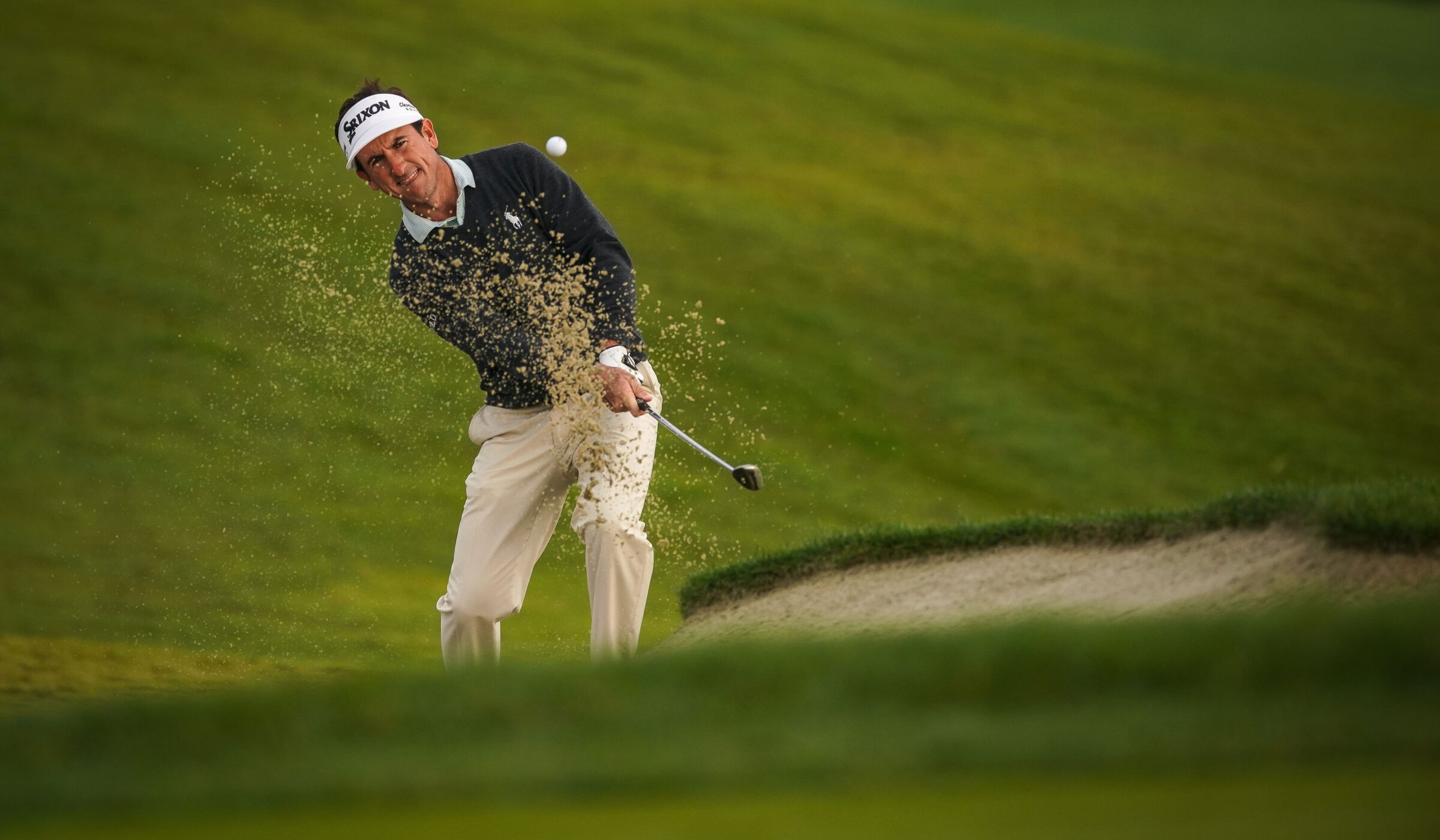
It's been an exciting few years in the United States, but it was time to return to his home, the European Tour, the circuit where he made his name with seven victories. He hasn't completely ruled out a return to the PGA Tour, not at all. In fact, he's working to regain a place among the top 50 golfers in the world and, in doing so, earn his way back to the world's premier tour.
He may or may not succeed, but whatever happens, he won't lose his way of being and acting, because Gonzalo is authentic, a true character. A conversation with him, even with the difficulties of transoceanic communication, is always a pleasure. He thinks, analyzes, and leaves nothing unanswered.
This year you're focusing on the European Tour calendar. Can we say that you're closing your chapter in the United States?
I'm going to focus entirely on the European Tour this year, that's true, but I wouldn't go so far as to say I'm closing a chapter. As you know, I still live in the United States; we're based in Florida, and the idea is to stay there as long as possible. It's also true that even though I'm not playing on the PGA Tour or the Web Tour, you never know. If things go well in Europe, which I hope they do, I can always think about returning to the PGA Tour via the Top 50 in the world, as I did in 2013. For now, rather than closing a chapter, we can say we're putting it on hold.
During these years in America you've played on the PGA Tour and Web.com Tour. Overall, what has your experience been like in the USA?
It's been a very enriching experience, despite not playing at the level I expected or know I'm capable of. But I've learned a lot playing on the best tour in the world and with the best players. The Web Tour also contributes to your development. In fact, it helps you see the amount of talent and grassroots golf that exists in the United States. It's very competitive, and only the top 25 make it to the PGA Tour, so it forces you to be on your toes. It makes you see how golf is changing, what it's becoming: a much more athletic, hard-hitting sport, which has little to do with what it was 15 years ago. It's been a very formative period from which I've learned so much, both personally and professionally.
Is there much difference between the European and American circuits? At what levels are those differences found?
Yes, there are differences, and they're significant. On the one hand, the PGA Tour travels the world, offering a greater variety of courses, people, and cultures, whereas in the US, everything is very similar. The courses, the people… it's more monotonous, but it's an incredible tour where making a bogey is extremely costly. Top golfers are excellent on both tours, but the average level is slightly higher on the PGA Tour, and the pool of talent is also stronger there.
On the other hand, golf is played differently there. The courses are somewhat wider, requiring you to hit the ball farther and harder. In Europe, due to the courses and the climate, the ball flies differently, resulting in a style of golf that I believe is better suited to my abilities.
Do you recommend a circuit like Web.com?
Absolutely. It's a super competitive circuit where you have to play exceptionally well to earn a spot on the PGA Tour. It's the only way to reach the top 50 in the world. Any young golfer with aspirations of playing on the PGA should know that the Web Tour is the path, but it's true that it's not easy because it's a very challenging circuit.
Last year you played 34 weeks, combining the Web.com Tour and the European Tour. What was it like playing and traveling so much?
It was a bit crazy. I'm not 25 anymore, and being away from home for so many weeks, without seeing the kids, isn't exactly pleasant. In total, it was about 200,000 kilometers by plane, but it was worth it. I got my European card that last week in Valderrama, but the downside was that I just missed out on the Web Open, finishing 76th. So it wasn't as positive as I would have liked, but even so, the effort was well worth it. It's definitely a physical and mental grind. This year I hope things will be calmer and I can pace myself for the last few years I have left competing. I want to make the most of them as much as possible.
Have you missed competing regularly on the European Tour during this time?
Yes, very much so. There's no doubt that this is where I feel most comfortable, and my friends are here. I have a better time. In the US, you spend a lot of time alone; everyone is more focused on their own thing. Although they welcomed me warmly, it's true that Americans are more individualistic. In the East, there's more of a close-knit group, and that makes missing a cut more bearable. You know that afterward you'll go out to dinner, have a laugh with your friends, and forget a little about what happened on the course. Being alone makes everything more difficult. Besides, I've also missed the staff, the umpires… I've been a professional on this tour for ten years, and that leaves its mark.
Looking at the calendar, which tournaments are you most looking forward to in 2019?
I was really looking forward to the desert tour, and especially the Qatar tournament, which I've always loved because of the course and the playing conditions… but I missed the cut. Looking at the schedule, I'm really looking forward to Valderrama, which is going to be a fantastic tournament and also offers spots for the British Open, and the Spanish Open, which, if it's finally played at the Club de Campo Villa de Madrid, will be another bonus, since that's where I developed as a player.
In short, it's a curious calendar that's been left with the PGA Championship moving to May and The Players Championship to March. It seems our main events will be in June-July and September-October, so I'll have to plan well to be ready for those parts of the season. I'd also love to play a major, especially the U.S. Open, which is held at Pebble Beach. I'll play the qualifiers to try and secure a spot.
What do you think of the young crop of Spanish professional golfers?
There's no doubt that some young players are coming up strong. I can't say much about Otaegui because I haven't had the chance to play with him, but judging by his results, there's no doubt he's a great player. He's especially good at match play and has a bright future ahead of him. As for Adriá Arnaus, he's a spectacular golfer with tremendous power and great natural talent. I hope he does incredibly well. They are possibly the two young Spanish players with the most promising futures. I also have a lot of faith in Jorge Campillo. He's been very solid for the last couple of years and it looks like he's about to break out of his shell, as we say when someone wins for the first time.
In your blog you refer to the new Rules of Golf, what is your opinion of them?
I generally like the new rules a lot, but it's like everything else; we've been playing with a certain set of rules for 35 years, and when you change them, it feels strange. The first reaction is always one of rejection, but I've read them carefully, I've had a chance to study them, and the truth is, I like them.
Things are changing, like the knee-high drop rule, which sounds ridiculous at first glance. I understand penalizing someone for a bad drop, for trying to gain an advantage, but in Rickie Fowler's case in one of the last tournaments, dropping above his shoulder, I doubt he could gain any advantage. It would be quite the opposite, in fact.
But this isn't a criticism, mind you. The rules are there for everyone, and it's our duty to follow them. If we don't, we'll be penalized, and that's that.
We've also read that you're working with the Focus Band system to manage states of concentration.
Psychology is fundamental, especially when things aren't going well. At those times, your mind starts racing, and it's easy to get caught in vicious cycles. Just as we work on the physical and technical aspects, we also need to train the psychological side daily. When things were going well for me on the golf course, I barely paid attention to my mental game, because just as there are vicious cycles, there are also virtuous ones. Now I've started with Focus Band, specifically with Jason Goldsmith, who previously worked with Jason Day and now works with Justin Rose. It's a very interesting method for achieving that state of present awareness, so to speak, where you use the right side of your brain, not the left, to think as little as possible and let the athlete perform. That would be the goal of Focus Band: to develop a routine that allows that athlete, that child, to play and not overthink.
Changing the subject, you're a popular and active person on social media, where you're not afraid to show your opinions on different current issues. Have you ever thought about 'cutting yourself off' on Twitter?
You have no idea how much I hold back! Yes, I like social media and I'm not politically correct at all, you already know that. I like to give my opinion and I bite my tongue, a lot.
What is your opinion of social media in general?
Except for Twitter, I'm not very involved in social media. I don't have Facebook or Instagram either. Twitter keeps you informed and allows for some interaction with fans. I imagine sponsors and others take into account how many thousands or millions of followers you have, although in my case, they wouldn't find many. You have to be careful, as a lot of misinformation spreads, but oh well, it keeps me entertained, especially when I'm alone.