
REPORT ON THE TRANSFORMATION OF THE IRRIGATION SYSTEM AT THE NATIONAL GOLF CENTER
Access below, in the Related Content section
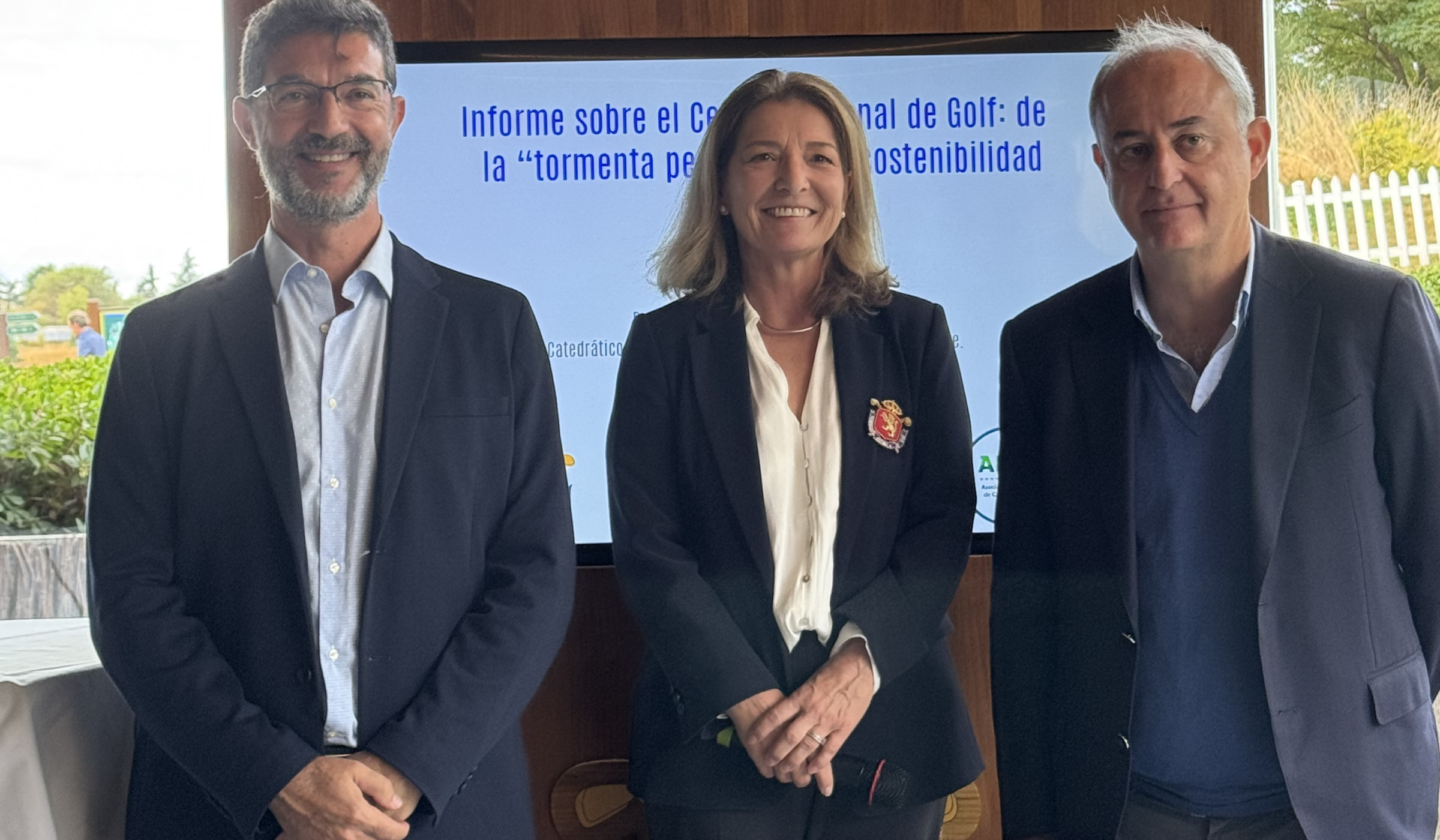
The National Golf Centre hosted the presentation of the Report on the transformation of the irrigation system of the National Golf Centre: a model of excellence and sustainability, a document promoted by the Royal Spanish Golf Federation (RFEG) and the Spanish Association of Golf Courses (AECG) and prepared by the University of Cadiz.
The study is an inspiring example of how technological innovation and efficient water resource management can become fundamental pillars for the sustainability of golf in Spain.
The transformation undertaken at the National Center's facilities demonstrates that it is possible to reconcile maintaining the quality of the field with a responsible and rational use of water, aligning with the objectives set by the sector to face climate and environmental challenges.
During the event, Mar Ruiz de la Torre, vice president of the RFEG, spoke, highlighting that “the proper use of water is part of the obligations of Spanish golf as a member of a society highly aware of these issues. In this sense, the National Golf Center, the public course that is the headquarters of the RFEG, located on land that once housed a landfill, was conceived from the beginning as a testing ground for the Spanish golf industry, where all kinds of innovations related to improving water consumption and sustainability have been tested for years.”.
In statements by Luis Nigorra, president of the AECG, “for the Association, from its beginnings, the management of the environment and water has been and is one of its strategic issues, which is why we promote together with the RFEG reports such as this one in which the sustainability of the sector is valued, with golf being a clear example of efficiency and innovation in water resources, which in turn are also a fundamental tool to improve the image of the sector through the dissemination of data.”.
The author of the report and professor of Environmental Technologies at the University of Cádiz, Juan Antonio López Ramírez, was in charge of presenting the actions and results of the project, a document that will serve as a reference for other courses and clubs interested in optimizing their irrigation systems and moving towards a more sustainable, innovative and environmentally conscious golf model.
EXECUTIVE SUMMARY – NATIONAL GOLF CENTER, A MODEL OF EXCELLENCE AND SUSTAINABILITY
CONTEXT AND TURNING POINT
In 2015, the National Golf Centre (CNG) faced a crisis that threatened its operational and financial viability.
· WATER CRISIS
The CHT reduced the water allocation by 33.3 % (from 9,000 to 6,000 m³/ha·year).
· LARGER ACTUAL SURFACE AREA
The irrigated area was corrected from 42.66 to 49.52 ha, increasing the water deficit.
• HIGH OPERATING COST
Regenerated water was incorporated (€0.45/m³), forcing the optimization of consumption.
THE PROBLEM: AN OBSOLETE AND INEFFICIENT MODEL
Original "wall-to-wall" type irrigation system, without precision or adaptation to the game.
Main deficiencies:
· Uneven coverage due to lack of triangulation.
• Lack of sectorization: uniform irrigation in areas with
different needs.
• Low uniformity → inconsistent turf and poor playing experience.
THE STRATEGIC SOLUTION
Adoption of a radical reform model with a dual objective: water efficiency and sporting excellence.
· Surgical irrigation
Water only in prime areas (tees, fairways, approach green, bunkers).
• Technical reengineering
Complete redesign with central axis and precise triangulation.
• Sector sprinklers
They allow for localized irrigation and greater control.
QUANTIFIABLE RESULTS
• Water Saving
-45.2 % daily consumption (from 2,028 m³ to 1,112 m³).
• Cost reduction
Estimated savings of €2,000/month in pumping energy.
· National example
Use of reclaimed water and alignment with the circular economy.
• Sports improvement
Firmer, more uniform turf with improved playability.
STRATEGIC CONCLUSIONS
· Project
Model of responsible water management and sports sustainability.
· Ensure
Long-term viability in the face of climate change and water scarcity.
· Create
A replicable model for other sports facilities in Spain and Europe.