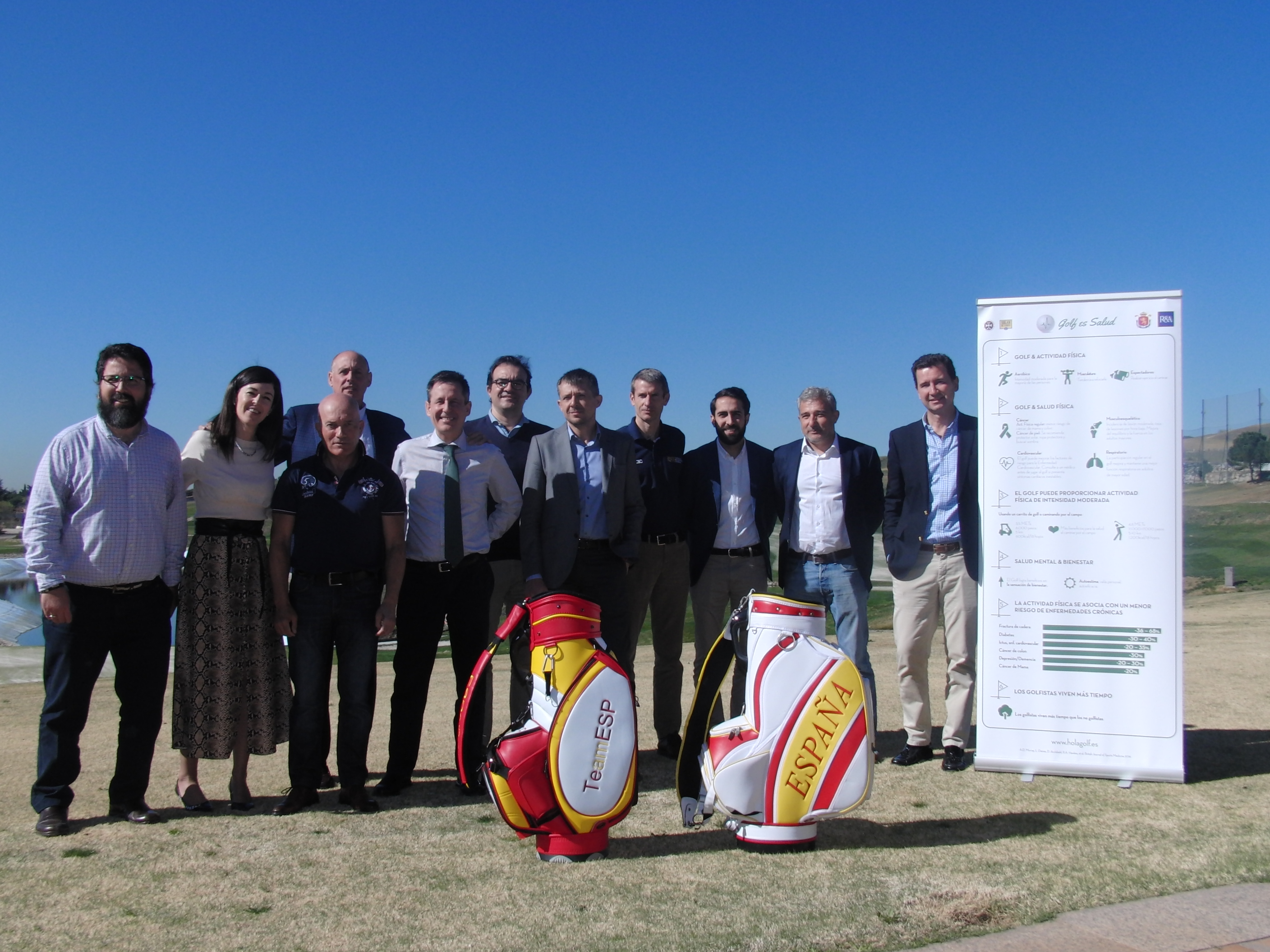
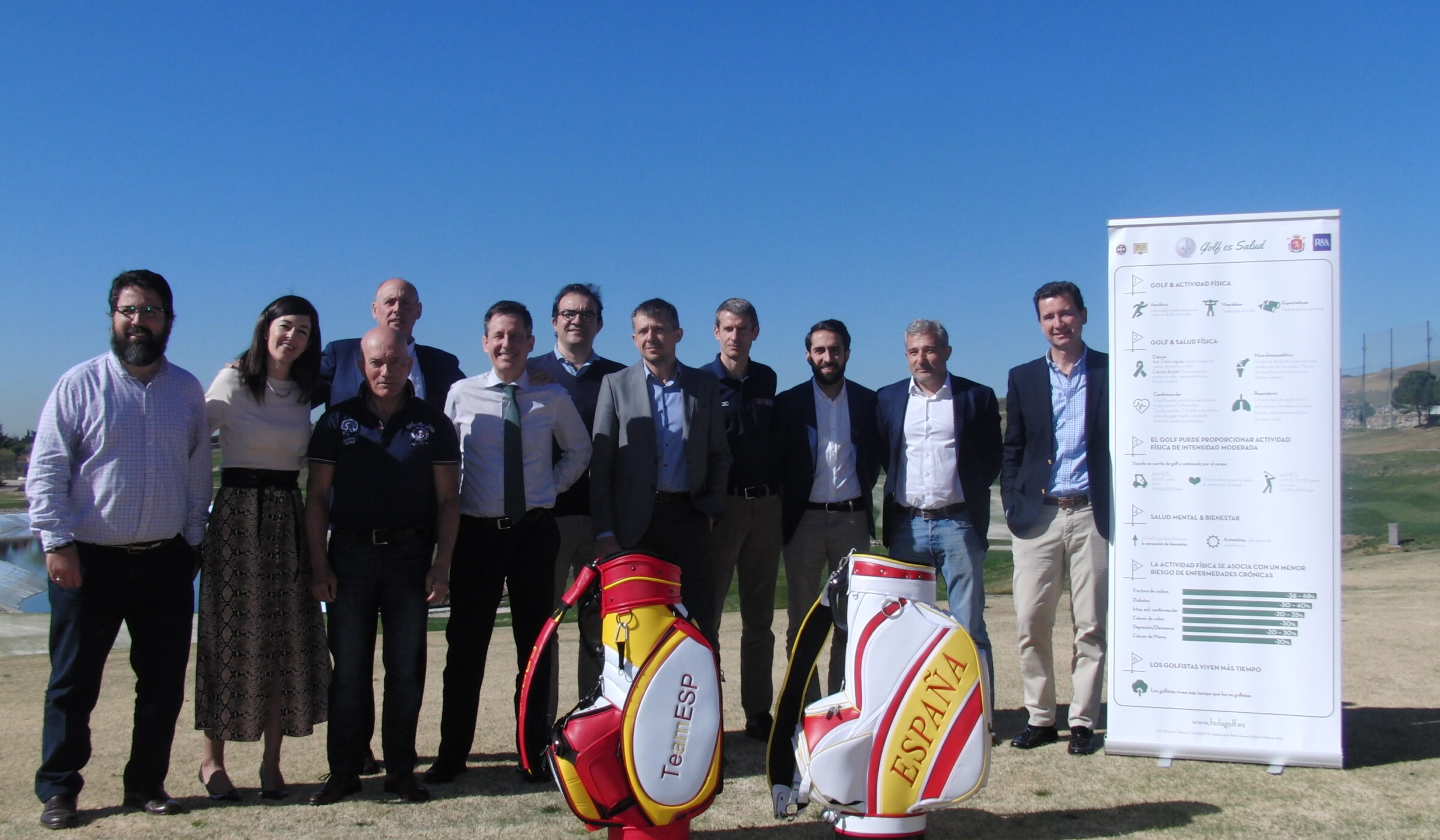
The Royal Spanish Golf Federation, in partnership with Solán de Cabras, hosted another session of the "Golf is Health" Breakfasts, a roundtable discussion featuring renowned medical specialists who explored the health benefits of playing golf. This time, the neurologists took the floor and concluded that the sport can be a powerful tool for preventing, combating, and slowing the progression of neurodegenerative diseases.
Xavier Guibelalde, Marketing Director of the RFEG (Royal Spanish Golf Federation), set the scene for those present by alluding to the study by Dr. Andrew Murray, who led the University of Edinburgh research that concluded that playing golf can extend a person's life by almost five years. His words, along with the welcome from Radio Marca journalist Guillermo Salmerón, who moderated the event, officially opened the proceedings.
José Antonio García Donaire –see outline of his curriculum and that of the other participants below–, a close collaborator of the RFEG in the dissemination of the values and benefits of the sport of golf in the whole of Spanish society, took the floor and put on the table the pathologies that were going to be discussed at the meeting, those related to Neurology.
“We know that golf and sports can influence physical and mental health because they affect social life. This isn't clinical evidence, but it is a trend derived from studies that need to be disseminated and studied to build evidence. What is certain is that by improving nutrition and environmental conditions and increasing exercise, we will gain in health,” he explained.
The nephrologist also noted that “there’s nothing like prevention to improve health and, incidentally, save the system money. For example, studies in Sweden have shown that the risk of mortality can be reduced by 40% with proper prevention,” he pointed out.
For his part, neurologist Marcos Llanero emphasized that “it has been proven that exercise prevents diseases. It has also been proven that diseases like Alzheimer's can be prevented by exercising. Family history plays a role, of course, but one can do their part to combat, as much as possible, the onset of the disease,” he explained.
“And we know that this physical activity is also fundamental to partially slowing down diseases already active in patients. All activity is good for people with neurodegenerative diseases, but golf can be especially beneficial, since other sports like running are more demanding,” he insisted.
Golf as a barrier to prevent stroke and the onset of dementia
Next up was neurologist Joaquín Carneado-Ruiz, who began his address by noting that these neurodegenerative diseases are more prevalent in people over 65. Having said that, and after asserting that golf has everything it takes to help patients, he lamented that the sport “still has to contend with social prejudices.”.
“We need to work on combating stereotypes. There are doctors who play golf because we know its benefits. I endorse the points in Dr. Murray's study, especially the one that says it reduces the risk of stroke and, importantly, dementia,” he noted.
Another focus of the meeting was analyzing the impact these illnesses can have on the patient's emotional state, and that's where psychologist Vanessa Abrines comes in. In her address, she centered on people's acceptance of a new situation. “Your life changes, and getting used to new, forced habits takes time; not everyone accepts it well. Nowadays, there's a concept of 'everything being perfect,' and that makes accepting adverse situations more difficult. That's where the family comes in; they must help and support that person,‘ she said.
Pablo Cabanillas, president of the Adapted Golf Committee of the Madrid Golf Federation, suffers from Multiple Sclerosis. His story reinforced Vanessa Abrines' words: “I played rugby all my life, and suddenly, at 20, I was diagnosed with Multiple Sclerosis. You wonder if you're going to die from it. I had to stop playing rugby and adapt to a new life. I found a new sport, which was golf. Turning the page and accepting reality is fundamental; if you don't, you fall apart,” he recounted.
“Nowhere do I feel better than on a golf course.”
Next up was Jacinto Garbajosa, an 8-handicap golfer who has suffered from Parkinson's disease for eleven years. “I decided I was going to do whatever I wanted, worrying only as much as necessary and enjoying life. Golf has helped me escape from this disease; I enjoy it immensely,” he said.
“Parkinson’s is often associated with tremors, but in my case, I’m more affected by rigidity. And I promise you, there’s nowhere I feel better than on a golf course, outdoors, focusing on the ball. For illnesses like mine, a sensory sport like golf is the perfect activity,” he explained.
His story led to that of Pablo Martínez Arroyo, a former professional basketball player, who shared with the panel the work of the Spanish Institute of Psychoneuroimmunology (UEPNI), of which he is a member. “Many athletes come to this institute for treatment to deal with chronic problems. In my case, it was patellar tendinitis that caused me daily pain. We found the source of the ailments, and I realized that I could regain the sensations of physical and mental enjoyment,” he said.
“And that’s why I decided to share this medical science. People come to our clinic every day with problems that we treat with our approach,” he added.
Furthermore, the former Estudiantes player emphasized "how positive golf is from the perspective that it's an activity the whole family can do together. That creates a priceless sense of well-being for the mind.".
That comment prompted Pablo Cabanillas to highlight that “the great thing about Adapted Golf is that it's a bridge to continue playing sports when illness strikes. You feel comfortable when you see that you can play golf with other people with Parkinson's and similar conditions. I started playing when I was almost 40, and it has been a very positive reinforcement for accepting my new situation,” he shared.
In conclusion, the specialists, some golfers and others not, unanimously agreed that this sport can and should be prescribed more frequently. “It’s more collaborative than competitive, it creates kinesthetic pleasure, and it provides a high volume of exercise,” concluded Joaquín Carneado-Ruiz.
Vanessa Abrines and Pablo Cabanillas added the finishing touch. “I didn’t know about it, and I assure you I’m going to recommend it,” said the psychologist; “I ask you to introduce people with illnesses like this to golf, because you can have Multiple Sclerosis and not only is the world not the end, but you can continue enjoying wonderful activities with it,” concluded the Madrid-born player.
Neurology, the fifth specialty to join the Golf Breakfasts is Health
It is worth remembering that Neurology is the medical specialty that deals with disorders of the nervous system, specifically focusing on the prevention, diagnosis, treatment and rehabilitation of all diseases involving the central nervous system, peripheral nervous system and autonomic nervous system.
Previously, these "Golf is Health" Breakfasts had featured leading medical experts in fields such as cardiology, traumatology, dermatology, and pediatrics. And in all these sessions, the conclusion was always the same: due to its health benefits, golf should be prescribed.
PARTICIPANTS
Xabier Guibelalde, Marketing Director of the RFEG
Dr. José Antonio García Donaire, nephrologist. European specialist in Hypertension and President of the Spanish Association of Arterial Hypertension.
Dr. Marcos Llanero, neurologist. Member of the Spanish Alzheimer's Conference (CEAFA).
Pablo Martínez Arroyo, former professional basketball player and member of the Spanish Institute of Psychoneuroimmunology (UEPNI).
Jacinto Garbajosa, golf player.
Pablo Cabanillas Boto, President of the Adapted Golf Committee of the Madrid Golf Federation.
Vanessa Abrines, sports psychologist.
Dr. Joaquín Carneado-Ruiz, neurologist. Member of the Madrid Association of Neurology.