
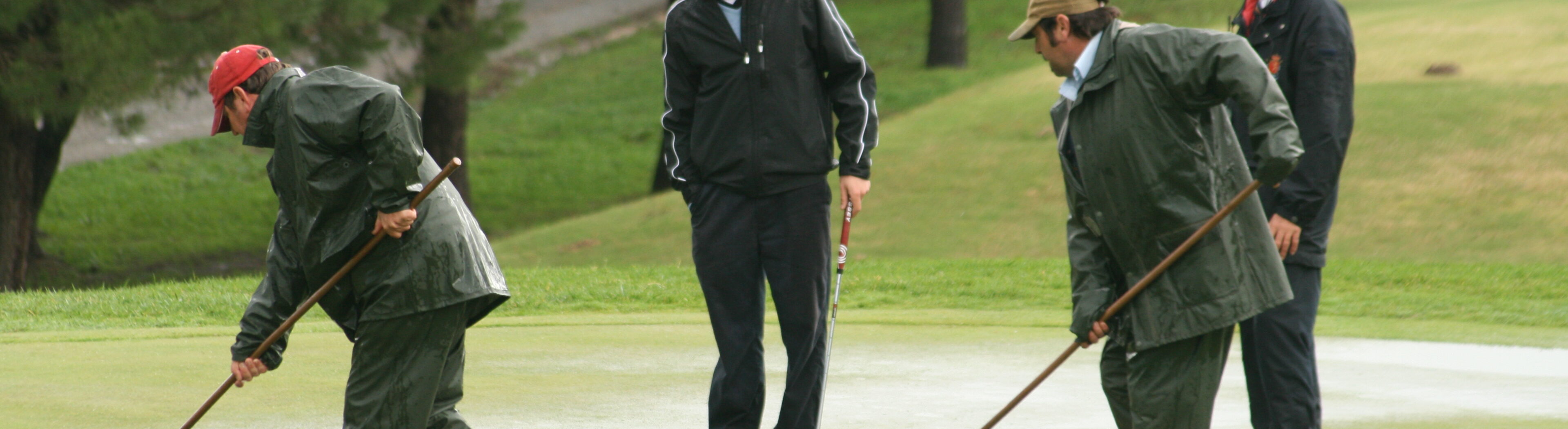
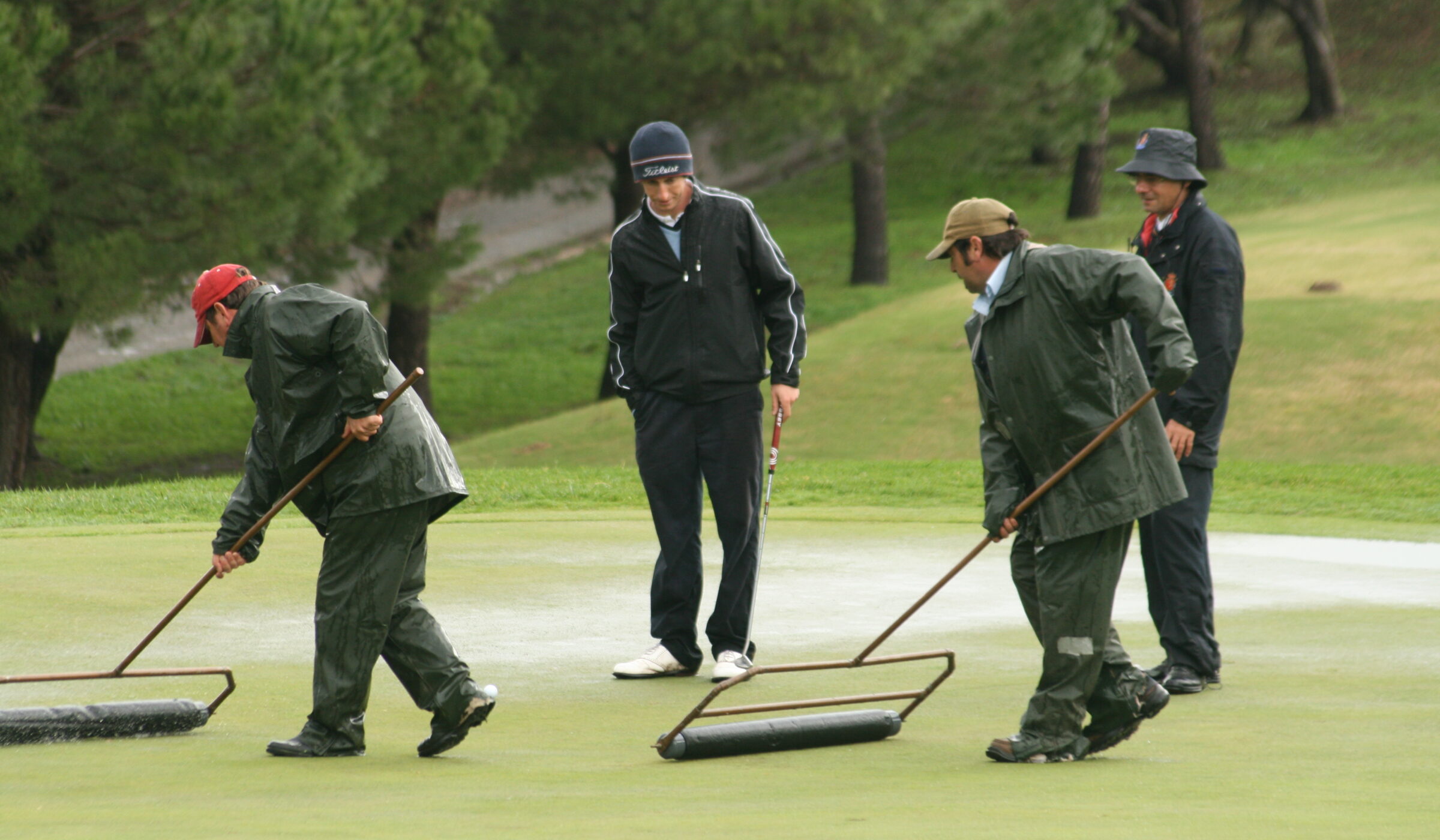
First up was the Iberdrola Open Cala Millor Mallorca on the European Tour, where we had several Spanish players, most notably Alejandro Cañizares. A thunderstorm struck mid-morning on Friday, forcing an immediate suspension of play. Due to this suspension, once play resumed after the storm passed, some players were unable to complete the second round because the tournament committee had to suspend play again due to lack of light.
Next came the Valero Texas Open on the PGA Tour, where Sergio Garcia was playing. The second round had to be suspended before play even began due to a thunderstorm. The heavy rain prevented play from continuing on Friday, so the second round was played entirely on Saturday, and the remaining 36 holes had to be completed on Sunday.
And finally came the LPGA's Bell Micro LPGA Classic, in which our Spanish representatives participated, with Azahara Muñoz achieving an impressive fourth place. An electrical storm forced the immediate suspension of play on Sunday, after which the tournament committee, considering the available weather forecasts, decided to cancel the fourth round, reducing the championship to 54 holes and holding only a playoff between the three players who had finished tied for the lead on Saturday.
About suspensions…
Rule 6-8b explains the procedure when the game is suspended by the Committee.
According to this Rule, “When play is suspended by the Committee, if the players in a match or group are between two holes, they must not resume play until the Committee has ordered play to resume. If they have started play on a hole, they may stop immediately or continue playing the hole, provided they do so without delay. If the players choose to continue playing the hole, they are allowed to stop before finishing it. In either case, play must stop after the hole is finished.”
Furthermore, decision 6-8b/2 explains that if only one of the players in the group has started playing the hole, that is, only one has played from the teeing ground before the suspension occurs, then play of the hole is deemed to have started, and all members of the group may continue playing the hole provided they do so without delay and then stop, either before or immediately after completing it.
However, the Note to Rule 6-8b tells us that “the Committee may stipulate in the conditions of a competition (Rule 33-1) that, in potentially dangerous situations, play must be stopped immediately after the Committee has suspended play. If a player does not stop play immediately, he is disqualified unless there are circumstances that justify not applying such a penalty as provided for in Rule 33-7.”
This immediate interruption of play, in force in these professional circuits (and also in the Competition Conditions and Permanent Local Rules of the Royal Spanish Golf Federation), is applicable, as the Rule states, in potentially dangerous situations, which include the danger of electrical storms.
Thus, if the Committee suspends the game due to the danger of lightning, the players must immediately stop playing, to avoid a very likely disqualification, and more importantly, to minimize the risk of being struck by lightning.
In the event of suspensions due to non-dangerous circumstances, players may remain on the field (and are sometimes required to remain on the field) to allow for a swift resumption of play. However, in the event of an immediate suspension due to a dangerous situation, players are required to leave the field immediately, for which purpose the Committee should have previously established an Evacuation Plan.
…and cancellations
But let's return to last week's cases. When it came to suspending play and canceling rounds, each committee acted differently. Indeed, on the European Tour, after the initial suspension, the Committee decided to resume play the same day, even though they most likely already anticipated that they wouldn't be able to finish the day on Friday. In the case of the PGA Tour, they announced from the outset that the day was canceled and would be played on Saturday. And in the case of the LPGA, they decided to cancel the fourth round definitively, declaring the holes already played on that fourth round null and void.
These different decisions are supported by Rule 33-2d, graphically titled “unplayable course.” According to this Rule, “if the Committee or its authorized representative considers that for any reason the course is not playable or that there are circumstances which make it impossible for the proper conduct of play, it may, in hole play or stroke play, order a temporary suspension of play or, in stroke play, declare the play void and cancel all scores for the round in question. When a round is canceled, all penalties incurred in that round are cancelled.”
Decision 33-2d/1, in turn, serves as a guide to the Committee regarding the circumstances under which a round should be cancelled. According to this decision, “there is no clear and definitive rule. The appropriate action depends on the circumstances of each case and must be left to the Committee’s discretion. Generally, a round should be cancelled only if it would be genuinely unfair not to do so. For example, if some competitors have started a round in clearly adverse weather conditions, conditions which then worsened, making play impossible that day, it would be unfair to the competitors who had started not to cancel the round.”
And when it comes to reducing the number of holes in the competition, as happened in the LPGA tournament, the guiding decision is decision 33-1/2:
33-1/2 Reduced number of holes during a Stroke Play competition
In a 72-hole stroke play competition played over four consecutive days, 18 holes must be played each day. On the third day, all competitors complete the first nine holes, but some continue playing the back nine. At this point, the course becomes unplayable due to heavy rain, and play is suspended. The rain continues, and play cannot resume that day. What options does the Committee have?
R According to Rules 33-1 and 33-2d, the Committee may choose between:
(a) resume play the following day and finish the third round and then play the final 18 that day or on a later day,
(b) cancel the third round, play it again the following day and play the last 18 on that day or a later day,
(c) reduce the number of rounds in the competition to three and finish the suspended third round the following day, or cancel the third round and play it again on a later day, or
(d) cancel the third and fourth rounds and declare the leader after 36 holes the winner.
Solutions (c) and (d) are not advisable. It is preferable not to reduce the number of laps in a race once it has started.
The Committee has no authority to reduce the number of holes in a stipulated round once it has begun.
As we have seen, the Bell Micro LPGA Classic Committee opted for option d), canceling the fourth round already started, and declaring the leader after the 54 holes played on the previous days the winner (or more exactly, making the three players tied for first place after the third round play a tiebreaker).
Although the decision advised against this option, the Committee ultimately decided it was the most appropriate under the circumstances. Indeed, the weather forecast for the remainder of the day, as well as for the following day, predicted further thunderstorms and heavy rain, which would likely have meant that the final day's competition would have had to be completed no earlier than the following Tuesday, disrupting the normal course of the next competition.
So that if you get suspended, it's just the return of the competition, give the following a review: Rules Section from the website.