Departure Time
According to Rule 6-3a, “the player must tee off at the time set by the Committee.” Up to this point, the penalty for not starting on time was disqualification, although committees could establish a condition of competition whereby, if the player arrived late to the first teeing place but within five minutes of their scheduled start time, the disqualification penalty was replaced by a penalty of losing the first hole in hole-in-hole play or two strokes in stroke play.
From January 1st, committees will no longer be required to establish the aforementioned competition condition. Indeed, from then on, “if the player arrives at the teeing ground, ready to play, within five minutes of their tee time, the penalty for not starting on time is the loss of the first hole in match play or two strokes on the first hole in stroke play.”
If he is delayed beyond those five minutes, then he will be disqualified, although if the Committee determines that there have been exceptional circumstances that have prevented a player from starting on time, there will be no penalty of any kind.
Decision 6-3a/1.5, also revised in the new edition of the Decisions on the Rules of Golf, clarifies what is meant by “exceptional circumstances”:
6-3a/1.5 Circumstances that justify waiving the disqualification penalty under Rule 6-3a
Q. Rule 6-3a Exception states that if a Committee determines that exceptional circumstances have prevented a player from starting at the scheduled time, there is no penalty. With regard to the following examples, what circumstances are considered exceptional to justify no penalty if the player does not tee off at the scheduled time?
1. The player gets lost on the way to the field.
2. There is more traffic than expected on the country road, causing me to arrive later.
3. A serious accident makes it take longer to get to the field.
4. The player's car breaks down on the way to the field.
5. The player was present at the scene of an accident and provided medical assistance or had to stay to testify as a witness to it, and if it were not for that reason he would not have been late for his departure time.
A: There is no fixed rule. The correct action depends on the circumstances of each case and should be left to the Committee's judgment.
Normally, only example 5 constitutes an exceptional circumstance covered by the Rule 6-3a Exception.
It is the player's responsibility to ensure they have sufficient time to reach the course and should allow for possible delays. (Revised)
Prohibited Actions at an Obstacle
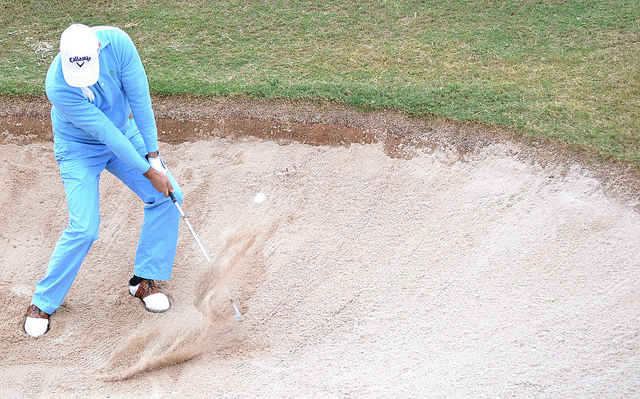
Rule 13-4 states that “except as otherwise provided in the Rules, before making a stroke at a ball which is in a hazard (whether a bunker or a water hazard) or which, having been lifted from a hazard, may be dropped or placed in the hazard, the player shall not:
a. Test the conditions of the obstacle or any similar obstacle,
b. Touch the ground in the obstacle, or water in the water obstacle, with your hands or a stick, or
c. Touching or moving a loose impediment that rests on or touches the obstacle.
However, from 1 January, the second exception to this Rule is amended so that a player will not be in breach of Rule 13-4 if at any time (i.e., even before he has made a stroke to his ball lying in a hazard) the player smooths sand or earth in a hazard, provided that, while the ball is lying in the hazard, this is done for the sole purpose of looking after the course and nothing is done that would breach Rule 13-2 with respect to the next stroke.
In other words, if your ball falls into a bunker, you may rake your footprints while walking towards your ball, even before making a stroke in the bunker, provided that you do so for the sole purpose of looking after the course, i.e., to comply with the Rules of Etiquette, and provided that by raking you do not improve, in relation to your next stroke, the position or lie of your ball, the area in which you intend to stand or swing, your line of play or a reasonable extension of that line beyond the hole; or the area in which you are going to drop or place a ball.
Keep an eye on the Rules section of rfegolf.es for details of other changes to the Rules that will come into effect next January 2012.