
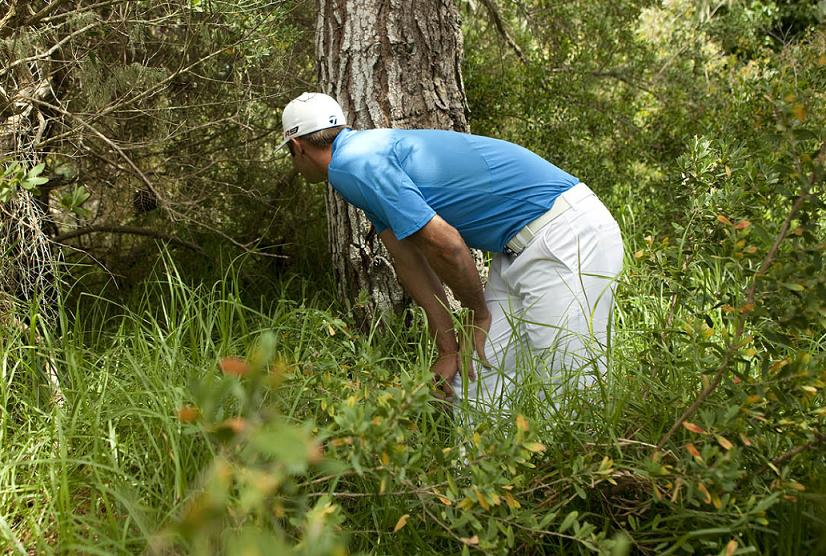
During the play of the 3rd hole of the final day of the US Open, Dustin Johnson's tee shot, the co-leader at that time, went well to the left, ending up in an area close to the 16th hole green, where there was a water hazard as well as lush vegetation.
The referee accompanying the group, Jim Hyler, President of the United States Golf Association (USGA), asked the observer ahead of the players if the ball had landed in the water hazard. However, the observer could not confirm this. Nor could the spectators nearby testify that the ball had been in the water hazard, since although they heard the ball, they did not see it land. Jim Hyler also requested assistance from television cameras, but no evidence could be obtained from them either, as they had lost sight of the ball while it was in flight.
According to Rule 26-1, “it is a question of fact whether a ball that has not been found after being struck into a water hazard is in the hazard. In order to apply this Rule [the Water Hazards Rule], it must be known or practically certain that the ball is in the hazard. In the absence of such knowledge or practical certainty, the player must proceed under Rule 27-1 [Stroke and Distance].”
And according to Decision 26-1/1, “if a ball has been struck into a water hazard and has not been found, the term “known or virtually certain” indicates the level of certainty required for the player to proceed in accordance with Rule 26-1. A player cannot assume that their ball is in a water hazard simply because there is a possibility that the ball might be in the hazard. If the ball is not known to be in the water hazard, in order for the player to proceed in accordance with Rule 26-1, there must be virtually no doubt that the ball is in the hazard. Otherwise, a ball that cannot be found must be considered lost outside the hazard, and the player must proceed in accordance with Rule 27-1.”.
To determine whether there is known or practical certainty about the ball's location, all available evidence must be considered, including any eyewitness accounts and the physical conditions of the area surrounding the water hazard. For example, if a water hazard is surrounded by a fairway where a ball could hardly be lost, there is greater certainty that the ball is in the hazard than there would be if there were thick rough in the area. Observing a ball splashing into a water hazard would not necessarily provide knowledge or practical certainty about the ball's location, as the ball may sometimes jump out of the water.”
In Dustin Johnson's case, the conditions around the water hazard made it impossible to definitively say that the ball could only be lost in the water hazard. Since it was virtually impossible to say with absolute certainty that the ball was in the hazard, once five minutes had elapsed from the moment the player or his caddie began searching for the ball, the ball was considered lost, and the player was obliged to apply Rule 27-1c, which states that, “if a ball is lost as a result of not having been found or identified as his by the player within five minutes after the player’s side or his caddie(s) have begun their search, the player must play a ball, under penalty of one stroke, as nearly as possible to the spot from which the original ball was last played (See Rule 20-5).” In Dustin's case, this meant returning to the tee and playing another ball from there, thus playing his third stroke.
However, as Johnson was preparing to return to the starting position, his ball was found in the water hazard. Unfortunately, this occurred after the five-minute search period had elapsed—specifically, five minutes and nineteen seconds. This raised the question of whether, now that the ball had been located in the hazard, Johnson should play his original ball (or move on from the water hazard) or whether his ball was indeed lost and he had to return to the starting position.
As we have already stated, a player may only apply Rule 26 Water Hazards if it is known or virtually certain that their ball is in the water hazard. In Johnson's case, since it was neither known nor virtually certain that his ball was in the water hazard before the end of the five-minute search period, the ball was lost, and therefore the player had to apply Rule 27-1 Lost Ball, returning to the tee to play his third stroke, which he did.
To know or be virtually certain how to apply the Rules of Golf correctly, regularly visit the Rules Section from the web.