
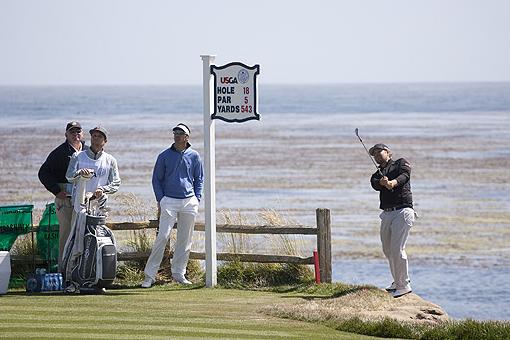
Ryan Moore's tee shot on the 17th hole, the longest par three at Pebble Beach Course at 208 yards, went well over the green, landing in the water hazard behind the teeing spot for the 18th hole.
Fortunately for Ryan, the ball landed on the edge of the cliff but within the water hazard. However, two things interfered with his next shot: a wooden guardrail and a large hole number signpost located at the teeing ground of the 18th hole.
With regard to the wooden guardrail, it is considered an immovable obstruction, and according to Rule 24-2b, “Except when the ball is in a water hazard or lateral water hazard, a player may obtain relief for interference from an immovable obstruction.” Since Ryan’s ball lay within the hazard, the interference from the immovable obstruction did not entitle him to relief without penalty.
However, Ryan also had interference from the hole number signpost, which, according to the US Open Local Rules, is considered a temporary immovable obstruction (TIO), which we have already discussed.
As we have explained on previous occasions, and as defined in Appendix I of the Rules of Golf, “a temporary immovable obstruction (TIO) is a non-permanent artificial object that has been frequently erected in connection with a competition and that is fixed and not easily movable.”
One of the peculiarities of the Local Rule relating to Temporary Immovable Obstructions (TIO), in force at the US Open, is that if the player has interference from the TIO, which in this particular case includes the intervention of the TIO directly between the player's ball and the hole, being on his line of play, the player is entitled to relief from the TIO, even if his ball lies within an obstacle (whether it is a water hazard or a bunker).
In general terms, according to this Local Rule, if the player's ball is in a hazard, there is interference from the Local Rule, and the player wishes to be relieved of it according to the Local Rule, he or she may do so:
i. without penalty, using as a reference the nearest site where it avoids interference from the TIO, not closer to the hole, but dropping the ball inside the obstacle, or
ii. with a penalty of one stroke, using as a reference the nearest site where it avoids interference from the TIO, not nearer the hole, but dropping the ball outside the obstacle.
And always, alternatively, the player can choose to take penalty relief outside the water hazard by applying Rule 26 of Water Hazards, instead of using this Local Rule.
Ryan opted for the first relief option under the Local Rule and took relief within the hazard without penalty. From there, he managed to salvage a respectable bogey, given the circumstances, which allowed him to finish the first round four over par, with a good chance of playing the weekend.
Although this Local Rule of Temporary Immovable Obstructions is not in effect in the vast majority of amateur tournaments, it is helpful to understand why we see these types of exceptions on the professional circuits, to avoid confusion when applying the Rules of Golf. And perhaps a visit to the Rules Section The web will save us from falling into the abyss.