My uncle from Madrid…
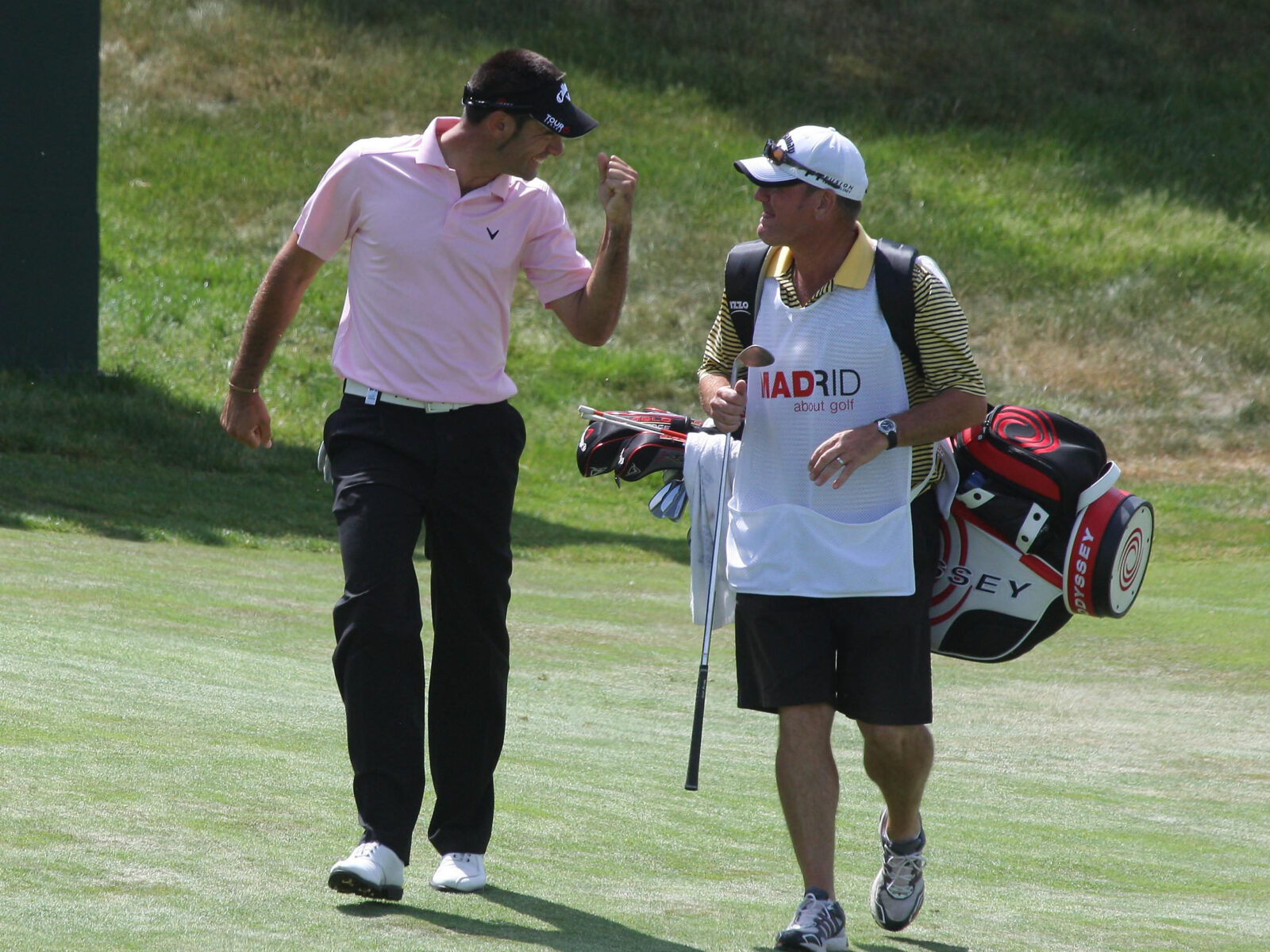
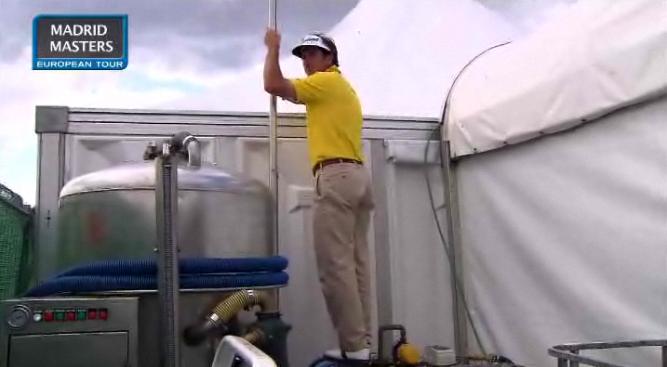
During the second day of the Madrid Masters held at the Real Sociedad Hípica Española Club de Campo, Gonzalo Fernández Castaño's tee shot on Hole 18 went towards one of the hospitality tents and could not be found.
According to Appendix I of the Rules of Golf, “where temporary obstructions have been erected on or near the course [such as hospitality tents, billboards, television towers, etc.], the Committee should define such obstructions as movable, immovable, or temporary immovable obstructions.” The European Tour’s Permanent Local Rules, like those of the vast majority of professional tours, consider hospitality tents as Temporary Immovable Obstructions (TIOs) and apply the Specimen Local Rule recommended for them in Appendix I of the Rules of Golf. The Royal Spanish Golf Federation only incorporates this Local Rule in professional competitions, as these are the only ones in which this type of Temporary Immovable Obstruction (TIO) is found.
The most noteworthy feature of this Local Rule is that it is one of the very few situations, other than the putting green, where relief is permitted for line-of-play obstructions. The rationale is that, in these types of competitions, it is common to find one of these obstructions (for example, a television tower) in line between the player's ball and the hole, whereas under normal circumstances, this obstruction would not be present. Therefore, the Rules deem it appropriate to provide line-of-play relief in these special circumstances.
But this Local Rule also tells us how to proceed if the ball cannot be found in the Temporary Immovable Obstruction (TIO). According to it, if it is known or virtually certain that a missing ball is in a TIO, the player is entitled to relief from the TIO, and to proceed with relief, we consider the ball to be at rest at the point where the ball last crossed the outer limits of the TIO.
In Gonzalo's case, the Committee considered several factors to determine whether it was known or virtually certain that the ball was in the TIO: the statements of the marshals who saw the ball enter the tent, the television footage that clearly showed the ball entering the tent but showed no evidence that the ball could have bounced off the tent and lodged outside, the fact that it was not easy to lose a ball in the area around the tent, and, of course, the player's own statements. After examining this evidence, the Committee decided that it was virtually certain that Gonzalo's ball was in the tent. Therefore, it proceeded to estimate the point where the ball entered the tent and, using this point as a reference, allowed the player to drop a ball within one club-length of, but no closer to, the hole from the nearest point where there was no interference from the tent.
In this respect, the Local Rule for Temporary Immovable Obstructions is very similar to what the Rules tell us to do in a situation that we might encounter on a daily basis on any golf course: How to proceed with a ball not found in an obstruction (Rule 24-3) or with a ball not found in an abnormal ground condition (Rule 25-1c).
Whether dealing with movable or immovable obstructions, or with an abnormal ground condition, if it is known or virtually certain that a missing ball is in that condition, we consider the ball to be at rest at the point where it last crossed the outer limits of the condition and use that point as the reference point for applying the rule of relief for obstructions or abnormal ground conditions. In other words, we act as if we had found the ball there and apply the rule with reference to that point.
…and Quicksand
While Gonzalo demonstrated a great knowledge of the Rules in Madrid, the same could not be said of him in Texas, at the Crowne Plaza Invitational held at the Colonial Country Club.
During the second round, Vijay Singh and Justin Leonard's tee shots from the 6th hole came to rest in the same fairway bunker, very close together. Vijay, who was farther from the hole, asked Justin to mark his ball, as it was interfering with his shot. Furthermore, since the tee was still bothering him even after being marked, Vijay asked Justin to move the tee two clubheads to one side.
Indeed, Rule 22-2 states that “except when a ball is in motion, if a player considers that another ball may interfere with his play, he may have it lifted.” And the Note to Rule 20-1 tells us that “If the ball marker interferes with the play, positioning, or stroke of another player, it should be placed to one side at a distance of one or more clubheads.”
The key detail was in the way he moved the marker on the two clubheads. We could see the care Justin took to ensure the clubhead didn't touch the bunker sand while he measured the two heads and moved the marker. Justin performed an incredibly difficult balancing maneuver that allowed him to measure the two clubheads without them touching the bunker floor.
And the player surely had in mind Rule 13-4 when it says that “except as otherwise provided in the Rules, before making a stroke at a ball which is in a hazard (whether a bunker or a water hazard) or which, having been lifted from a hazard, may be dropped or placed in the hazard, the player shall not:… touch the ground in the hazard… with his hands or a club.”.
But what Justin forgot is that the first exception in Rule 13-4 itself says that as long as nothing is done which constitutes testing the conditions of the obstacle or improving the lie of the ball, there is no penalty if the player touches the ground of the obstacle when measuring or marking the position of a ball under a Rule.
So that when you need to apply the Rules on the field, you don't feel like you're walking on quicksand, we're preparing a basic Rules course that you'll soon be able to follow online. In the meantime, take a look around the Rules Section from the web. And if you have an uncle who plays golf, invite him to take a stroll through the Rules section with you.