
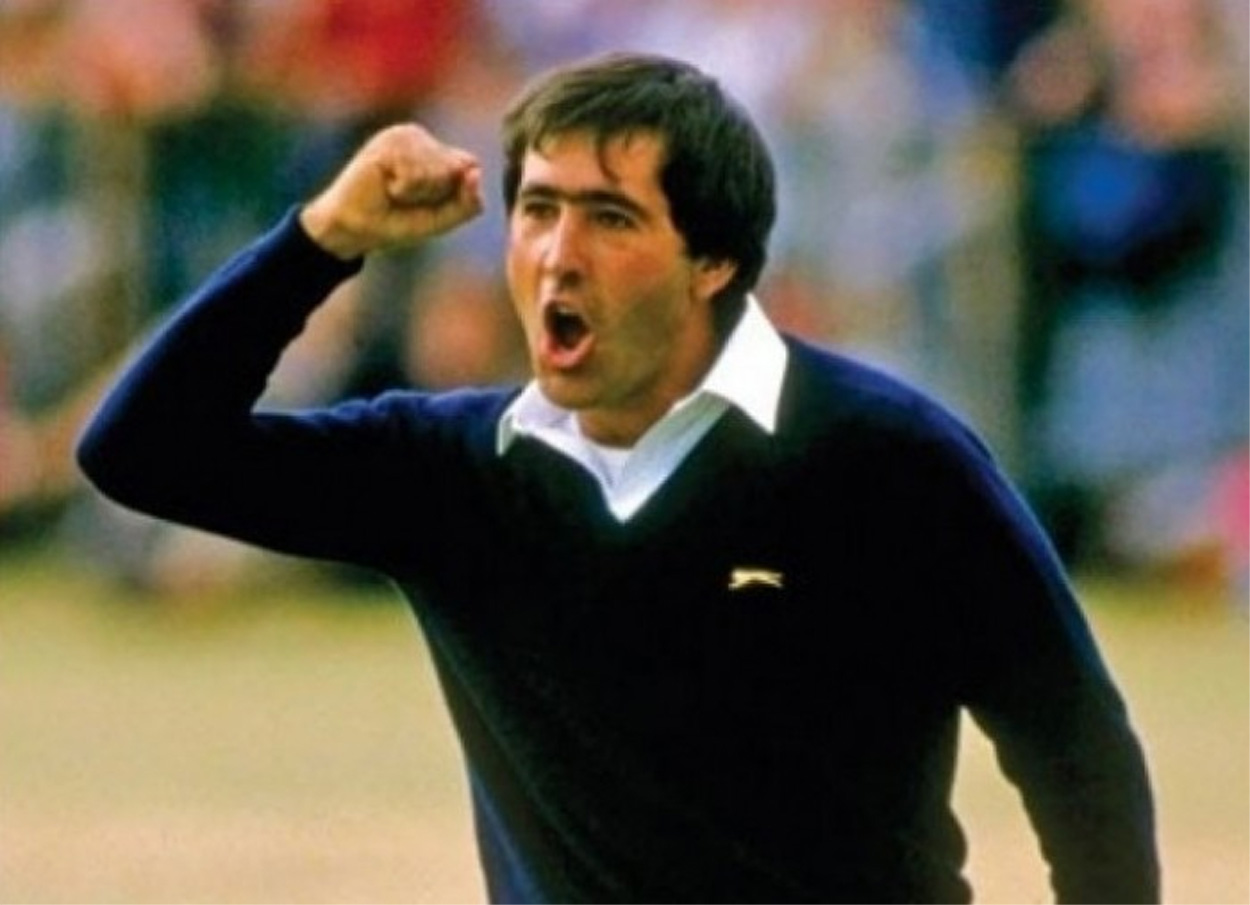
. His contribution to golf in particular and to sport in general will forever make him one of the greatest figures in the world.
. His figure became legendary thanks to the talent and effort displayed for more than 30 years across five continents.
. His stature transcends all his individual titles when one reviews all the work he has done for years in support of golf in our country.
Fifteen years without Seve, fifteen years without a very possibly irreplaceable figure who has become a legend thanks to the talent and effort exhibited during more than 30 years of dedication to the sport of golf throughout the world.
Severiano Ballesteros, the most outstanding Spanish golfer of all time, died in the early hours of May 7, 2011 at the age of 54, at his home in Pedreña, surrounded by his family, as a result of the illness that had afflicted him since he was diagnosed with a brain tumor in August 2008 after fainting at Barajas airport.
He underwent surgery up to four times before starting chemotherapy treatment,
Severiano Ballesteros has since been an example of struggle and overcoming adversity.
With a brilliant track record in his sporting career, adorned with all those titles that every golfer longs for, three British Opens (1979, 1984 and 1988), two Masters of Augusta (1980 and 1983) and three Ryder Cups (1985, 1987 and 1995), in addition to one of them, unforgettable in Valderrama 1997, as captain, Severiano Ballesteros forged a legend that went beyond the limits of golf to become one of the great icons of Spanish, European and world sport.
Severiano Ballesteros last participated in a golf tournament in Spain at the 2005 Spanish Open. He later attempted to make the leap to the American Senior Tour, but withdrew in the first event and never played again.
The last time Severiano Ballesteros was seen was on April 11, 2011, during a charity tournament organized by his Foundation, in which the Cantabrian appeared in a video to thank everyone for their efforts in the fight against cancer and research into brain tumors.
The story of a brilliant golfer
Before that, four years earlier, he went to Carnoustie, in Scotland, on the very eve of a new edition of the British Open, which he himself helped to enhance, to say goodbye, to proclaim to his huge number of followers that he was retiring from the active practice of golf in July 2007.
Severiano Ballesteros, the best Spanish golfer of all time and one of the truly greats in the history of world golf, acknowledged that the bitter day had arrived because he had stopped feeling a real desire for that golf that had given him so much and for which he had worked so hard to give back as much as possible of what he had received over three decades of glory.
Just as happened in their day with the great figures who have stood out in history for their contribution to their respective disciplines, the career of Severiano Ballesteros continues to be analyzed in detail to conclude that it is a true legend forged thanks to the talent and effort exhibited for more than 30 years throughout the world.
Not surprisingly, his legacy remains very palpable thanks to his decisive influence on the development of Spanish golf, the Ryder Cup and the European Tour.
The towering figure of the boy from Pedreña changed golf forever. The Scottish course of Carnoustie and July 16, 2007, were the place and day chosen by our great Severiano Ballesteros to utter the two words that millions of fans around the world would have preferred never to hear: “I’m quitting.”.
That boy from Pedreña
Following the example of many legends, Seve's story closely resembles that of a fighter, a person who climbed to the highest peaks from humble beginnings. In his case, his dream began in the small Cantabrian town of Pedreña, where in 1928 a golf course was inaugurated that would change the perception of this sport, both in its gameplay and its social dimension.
That caddie who started hitting balls on the endless beaches of the Cantabrian coast fell in love with golf clubs the moment he set foot on the greens of Pedreña. So strong was that infatuation that the teenage Seve would sneak past the fences at night to play a few holes with nothing but the moon for company.
Whether it was due to the difficulties of playing on sand, hitting the ball with hardly any light to follow its trajectory or – as so many maintain – due to his extraordinary innate ability, in the boy from Pedreña grew a superior and excellent talent that would very soon provoke the most extreme reactions among the fans, always eager to see how those shots impossible for others became success in the hands of Severiano.
Not surprisingly, any performance by Ballesteros, on any golf course in the world, was always followed by a veritable legion of fans eager to witness this different conception of golf, far removed from orthodoxy but characterized by its extraordinary beauty and spectacular nature.
Years later, a former player of Ben Crenshaw's stature eloquently captured the genius of the Cantabrian: "He is capable of executing shots that I cannot even visualize in my dreams.".
Genius and talent combined with an overwhelming charisma
That gift—an overwhelming charisma that became evident every time he sank an impossible putt and raised his fist in fury—was the main reason why a teenage Seve managed to turn professional with hardly any help. It was on March 22, 1974—before he had even blown out 17 candles on his birthday cake!—that he took the decisive step.
His very young age was no obstacle to him reaching the top spots from the moment he entered the professional world, achieving his first victory in the Spanish Under-25 Championship. Fate smiled upon him, allowing him to make his debut in Pedreña, thus beginning a meteoric rise. Indeed, that same year, he secured another victory in the Vizcaya Open and a second-place finish in the Santander Open.
1976, the key year
Severiano Ballesteros' star began to shine in 1976, the year in which that unknown player with an unpronounceable name for the Anglo-Saxons broke in among the greats to come within a step of winning an entire British Open – those who were at Royal Birkdale will never forget that chip he rolled between two bunkers to leave the ball a foot from the flag and achieve a birdie on the last hole – and the year in which he won the World Team Cup with Spain in California.
In between these two achievements, he triumphed at the Dutch Open, overcoming a four-stroke deficit against Arnold Palmer on the final nine holes to lift the Lancôme Trophy. Two years later, at just 20, he had already won on all five continents, but he lacked that great victory, that major championship that would consecrate him in the eyes of a Spain that barely knew golf and an international fanbase that followed his every shot as if it were his last.
Such magic in every shot deserved a greater reward. This came in 1979, when he won his first British Open, becoming the youngest winner of the 20th century in this prestigious and exclusive competition. From that moment on, the majors fell by the wayside, a natural progression that crossed the Atlantic to land in the United States.
The Masters Tournament in Augusta, the major championship that only one player born outside the United States had ever won until then, opened the doors of glory to a European golfer for the first time in 1980. And of course, it opened them for Seve. Twenty-three birdies and an eagle meant that, with nine holes to play, his lead over the second-placed player was ten strokes.
That day, at the same time as the 18th, he received one of the recognitions that made him most excited in the context of his sensational sporting career: the bells of his town rang in honor of the champion.
Shortly after, in 1983, came his second Masters title at Augusta, and a year later, his second British Open, before adding his third British Open victory to his historic record in 1988. By then, Severiano had already won over the entire golfing world.
The Ryder Cup, a golden chapter apart
And if we agree, because it is only fair, that players as unique as Seve are a rarity that every fan should enjoy, we must also agree that no other competition is as unique as the Ryder Cup, which had to be opened up to make room for the genius and his continental colleagues.
Inevitably, they were destined to meet and get along, despite the fact that one of the Cantabrian's great sporting disappointments was his exclusion from the 1981 duel against the United States. That bitter taste was forgotten with his three victories as a player (1985, 1987 and 1995), his triumph as captain (1997) and with many great moments in the form of decisive putts, dramatic playoffs, celebrations and tears.
The high point of the love affair between Seve and the Ryder Cup occurred in the aforementioned 1997 edition, which was held for the first time in Spain in response to his persistence in bringing the best golf in the world to the Spanish people, a historic milestone that our sport should always recognize as it deserves.
Much more than a player
The legend of Severiano Ballesteros was forged, thanks to his talent and effort, by dozens of victories, by 61 weeks as world number one, by countless awards in all parts of the golfing world, by so many things that made his sporting career an example to follow, sprinkled with historical connotations that will remain in the annals of golf forever.
However, his stature far surpasses all his individual titles when one considers his entire contribution to golf in our country. He is partly responsible for Spain now having over 315,000 registered golfers and the fact that the sport can be played on around 400 courses, 101 of which are public.
Not surprisingly, his work to popularize golf is not limited to Spain alone, but extends far beyond. His refusal to play the entire PGA Tour and his insistence on combining tournaments on both sides of the Atlantic revitalized the European Tour at a time when it was facing difficulties. These difficulties were overcome thanks, in large part, to Severiano Ballesteros's dedication to strengthening the Tour, which resulted in hundreds of players benefiting from much more lucrative prizes over the years.
While it is true that in recent years his sporting successes had diminished considerably due to his increasing back problems, his popularity had grown significantly. The Royal Spanish Golf Federation itself paid him a warm tribute in 1999, with the presence of many of his closest companions from his 30-year career.
And it is certainly true that that tribute could only serve to settle a small part of the debt that golf owed to the genius of Pedreña. To the legend of Severiano Ballesteros.