


Since the 2019 Rules of Golf came into effect, we've received this question many times, and it's clear there's quite a bit of confusion surrounding it. Therefore, it's important to clarify that the rules don't generally allow a player to change balls whenever they want during a hole; it's only permitted in very specific situations. Let's explain.
As a general principle, the Rules of Golf require that a player use the same ball from the moment they tee off in the starting area until they hole out (Rule 6.3). However, some rules allow a player to change the ball they are using to play a hole for a substitute ball, which then becomes the ball in play. These cases are:
· When taking relief under a rule, including when dropping a ball or placing a ball (such as when a ball will not remain in the relief area or when taking relief on the green), the player may use the original ball or another ball.
· When playing again from where the previous shot was made, the player may use the original ball or another ball.
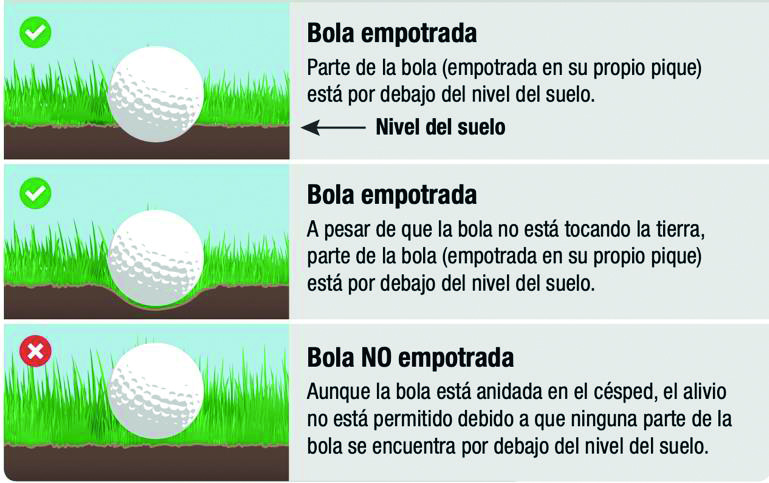
Consequently, a new ball may be dropped when taking any form of relief. Thus, ball replacement is permitted when taking relief from temporary water, an immovable obstruction, ground under repair, an animal hole, a penalty area, an embedded ball, an unplayable ball, etc. The original ball may be used, but it is not required.
Similarly, and this is what usually causes the confusion that has become widespread among players, the replacement of the ball is allowed when relief is taken as a result of the application of the local "ball placement" rule or also called the "winter rule", when that local rule is in force.
In that case, since it is also a relief situation, the original ball or another ball can be used.
As we've seen, amateur golfers will have many opportunities to change the ball during play, so we're frequently asked if the same can be done when lifting the ball on the green. And the answer, which is generally no, has its nuances.
Rule 13.1b states verbatim that:
“A ball lying on the putting green may be lifted and cleaned (see Rule 14.1). The spot where the ball rests must be marked before it is lifted and the ball must be replaced on its original spot (see Rule 14.2).”.
As we can see, in this case it is not a situation of relief, but the rule authorizes lifting and cleaning the ball that rests on the green, with the obligation to replace it, so the original ball must be used without it being possible to replace it.
Obviously, when there is a relief situation for a ball lying on the green (temporary water, immovable obstruction, ground under repair, etc.) or when it is necessary to play again from where the previous stroke was executed on the green (for example, because the stroke is cancelled), then the original ball or another ball could be used.
Likewise, we must not forget that there are other situations in which the original ball can be replaced during the game (for example, when the ball is cut or cracked, when interrupted play is resumed, when another player plays the ball as the wrong ball, etc.).
In short, you cannot change the ball during the game of the hole in general, but only when the rules we have seen allow it.
By Manuel García Mancebo
National Judge-Referee




-1600x1200.jpg)