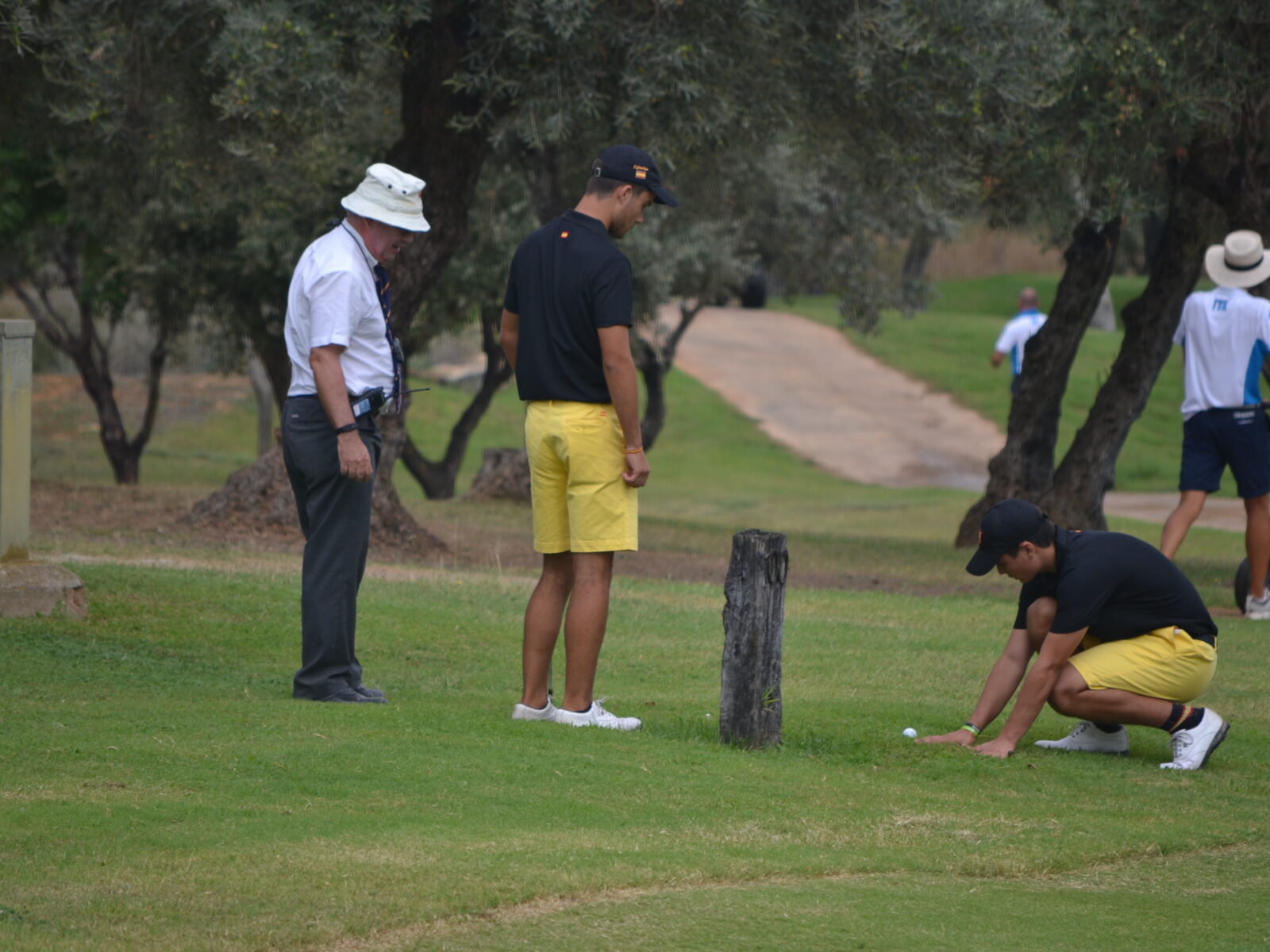
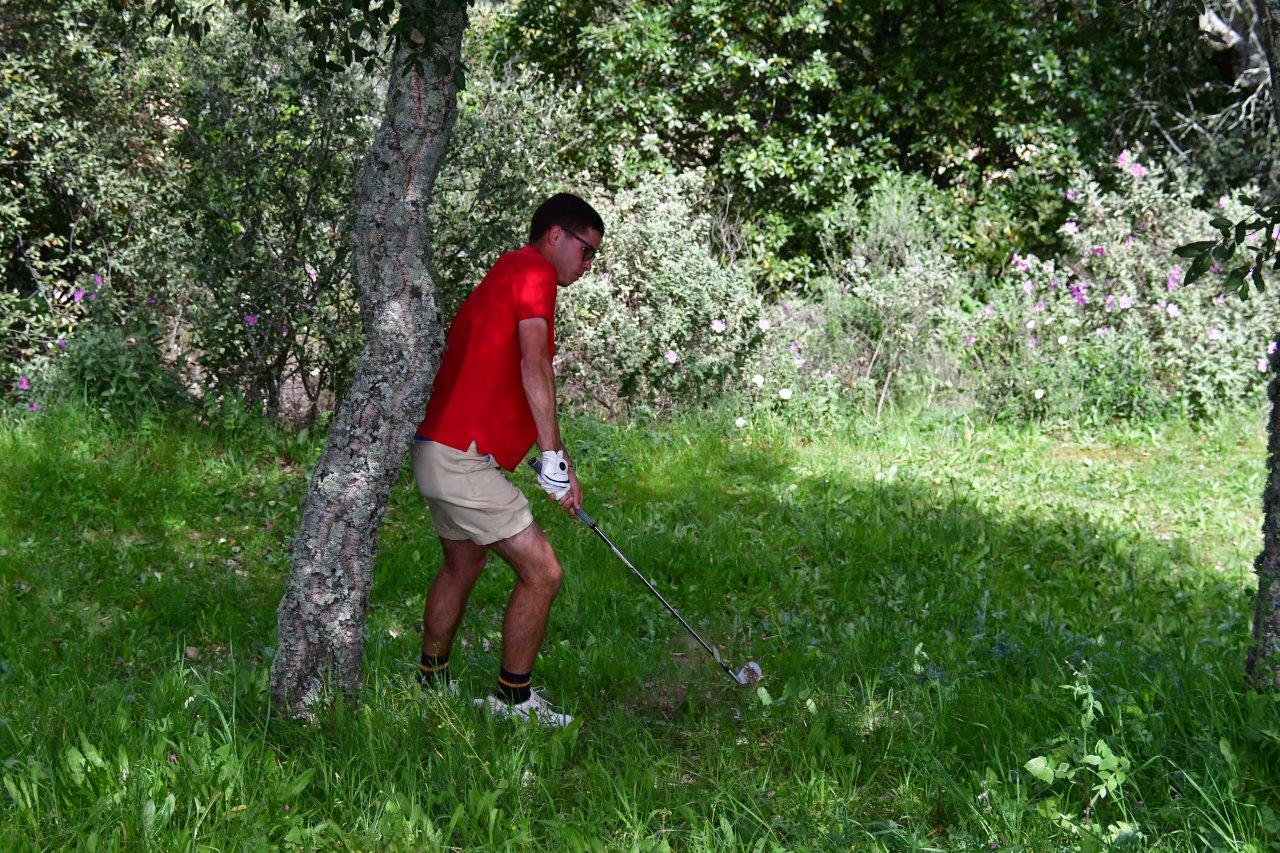
The RFEG Rules Committee has prepared a series of articles to further promote and teach the Rules of Golf, ensuring that playing our sport is as enjoyable as possible while always adhering to current regulations. The fourth article addresses how to avoid disqualification for playing from the wrong spot.
How to avoid being disqualified for playing from the wrong place
Did I really commit a serious infraction? Many of us have surely heard at some point on the 19th hole at our club or another club where we've played in a tournament that a player has been disqualified. On some of those occasions, we've been told that the disqualification resulted from playing from the wrong spot and committing what the Rules of Golf define as a "Serious Infraction.".
Most of the time, these disqualifications occur without the players being aware of the Rules being broken and without them fully understanding the reasons for the unfortunate disqualification. Let's see what the Rules say and how we can avoid these situations on the field.
What is meant by playing from the wrong place?
The rules tell us that a player's ball lying at rest on the course must be played as it lies, except when the Rules require or permit the player to:
• Playing a ball from another location on the course, such as when we hit our ball out of bounds, when we take relief, with or without penalty, from a condition on the course, such as a concrete buggy path or a penalty area.
• Lifting a ball and then placing it back in its original position, as we normally do on the green, either because it interferes with another player's line of play or simply because we want to clean it before playing our putt.
Now, once we understand this principle of the game of golf, we must keep in mind that when we play from any place on the course other than where the player should or is allowed to play their ball under the Rules, we say that we have played from the Wrong Place.
Typical examples of playing from the wrong place are:
• Playing a ball after replacing it on the wrong spot, or without replacing it when required by the Rules.
• Play a dropped ball from outside the required relief area.
• Taking relief under the wrong Rule, so that the ball has been dropped and played from a place not permitted by the Rules.
• Playing a ball from a prohibited playing area or when the prohibited playing area interferes with the player's intended stance or swing area.
We should clarify that playing a ball from outside the teeing area when starting a hole or when trying to correct that mistake is not playing from the wrong place; it's playing from outside the teeing area. But we'll address this scenario in more detail in a later article (Rule 6.1b).
And why have we committed a serious infraction?
The Rules explain that a Serious Breach in stroke play occurs when playing from the wrong place could give us a "significant advantage" compared to the stroke we should have made from the correct place.
When determining whether there was a serious infraction, we would have to make a comparison in which the factors to take into account would be:
• The difficulty of the shot from the place where we should have played and from where we have done it incorrectly.
• The distance from the ball to the hole,
• The effect of the presence of obstacles on the playing line
• The conditions that affect the shot. This concept includes, among other variables, the lie of the ball, the swing area, the stance area, the line of play, and the relief area.
From what we've read so far, it's clear that there's a key factor to consider when discussing a Serious Infraction: having gained a "significant advantage" by playing from the wrong position.
Before delving into other considerations, we must clarify that the concept of a serious infraction for playing from the wrong place is only applicable to stroke play and not to match play, where, if this circumstance occurred, the player would simply lose the hole without being disqualified.
What JB Holmes' disqualification could have meant at the 2016 WGC Cadillac Championship, but wasn't.
PGA Tour player JB Holmes - better known by the initials JB, like the famous Scotch whisky brand - during the first hole of the final round, "pulled" his tee shot to the left of the fairway, sending his ball into a red penalty area (red stakes).
Under the Rule 17.1d lateral relief option, and under a one-stroke penalty, JB Holmes chose to drop within two club-lengths on the opposite side of the penalty area and at a point equidistant from the hole to the point where his ball last crossed the penalty area, an option permitted under the rules prior to 2019 and under which, currently, this lateral relief option could only be available on the opposite side if implemented, under a Local Rule, by the Test Committee.
However, this was not where JB dropped a ball. The player correctly identified the equidistant spot on the opposite edge of the penalty area, but instead of dropping within the required two club-lengths, he dropped approximately 25 meters behind the line that determined the spot where he should have dropped and the position of the hole. This option is a hybrid of the choices allowed by Rule 17.1, and unfortunately, he played from the wrong spot.
When JB reached the green, he was informed by the referee of the incorrect drop and that he had incurred a two-stroke penalty for playing from the wrong place. The referee also informed him that the Committee considered him to have committed a serious breach of contract. Accordingly, the referee directed JB to return to the penalty area and take proper relief under any of the options in Rule 17.1d.
It's not all about gaining distance.
We see how, curiously, the Committee decided that, despite having played 25 meters further back than the Rule allowed, JB Holmes obtained a “significant advantage”, since by playing 25 meters further away from the flagstick position it allowed the player, with his 3 wood, to play a full stroke of 280 meters, directly to the green, being able to do it over some trees located on his line of play.
In the case of JB Holmes, the fact that an umpire witnessed the infraction and informed him that the Committee had deemed it a serious offense undoubtedly facilitated the successful resolution of the problem. A serious infraction, such as playing from the wrong tee, must be corrected before playing from the next teeing area; otherwise, the player will be disqualified. Obviously, this isn't always possible on a golf course.
How to complete a hole after playing from the wrong spot in stroke play
If we realize we've played from the wrong position, the next step depends on whether a serious infraction could have occurred. In other words, we need to determine if playing from the wrong position could have given us a significant advantage.
• If we conclude that it is not a serious infraction, we must finish the hole with the ball played from the wrong place, without correcting the error.
• If we determine that it is a serious breach, we must correct the error by completing the hole with a ball played from the correct place, in accordance with the Rules.
Although we have already pointed this out, it is important to reiterate that there is a point of no return to avoid disqualification. This means that if there is a serious infraction and the error is not corrected before making a stroke to start another hole, or, if it is the last hole of the round, before handing in the scorecard, we would be disqualified.
How to proceed if we have doubts about whether the infraction is serious or not
We should finish the hole with the original ball played from the wrong place and a second ball played from the correct place, according to the Rules. It is very important to remember that the Committee must be informed of the facts before submitting the scorecard. This applies whether the player finished the hole with only that ball or with two balls (and even if the score for the hole is the same with both balls). Failure to inform the Committee will result in disqualification.
Some Final Conclusions
• There are a number of factors – cited above – that the Committee will have to take into account when deciding whether the player has gained a significant advantage by playing from the wrong place, not just the possible distance gained.
• If we have played from the wrong spot and are unsure whether there is a serious infringement, we should play a second ball from the correct position. This will always prevent problems.
• We must always report the facts to the Committee. The Committee will tell us whether there has been a serious infraction or not, and also the score of the hole we must record.
• The serious infraction for playing from the wrong place is only applicable to the stroke play game modality, since in match play, playing from the wrong place with or without a serious infraction will always result in the loss of the hole.
By Vicente Juan Olmos Blázquez
National Referee Judge of the RFEG



-1600x1200.jpg)