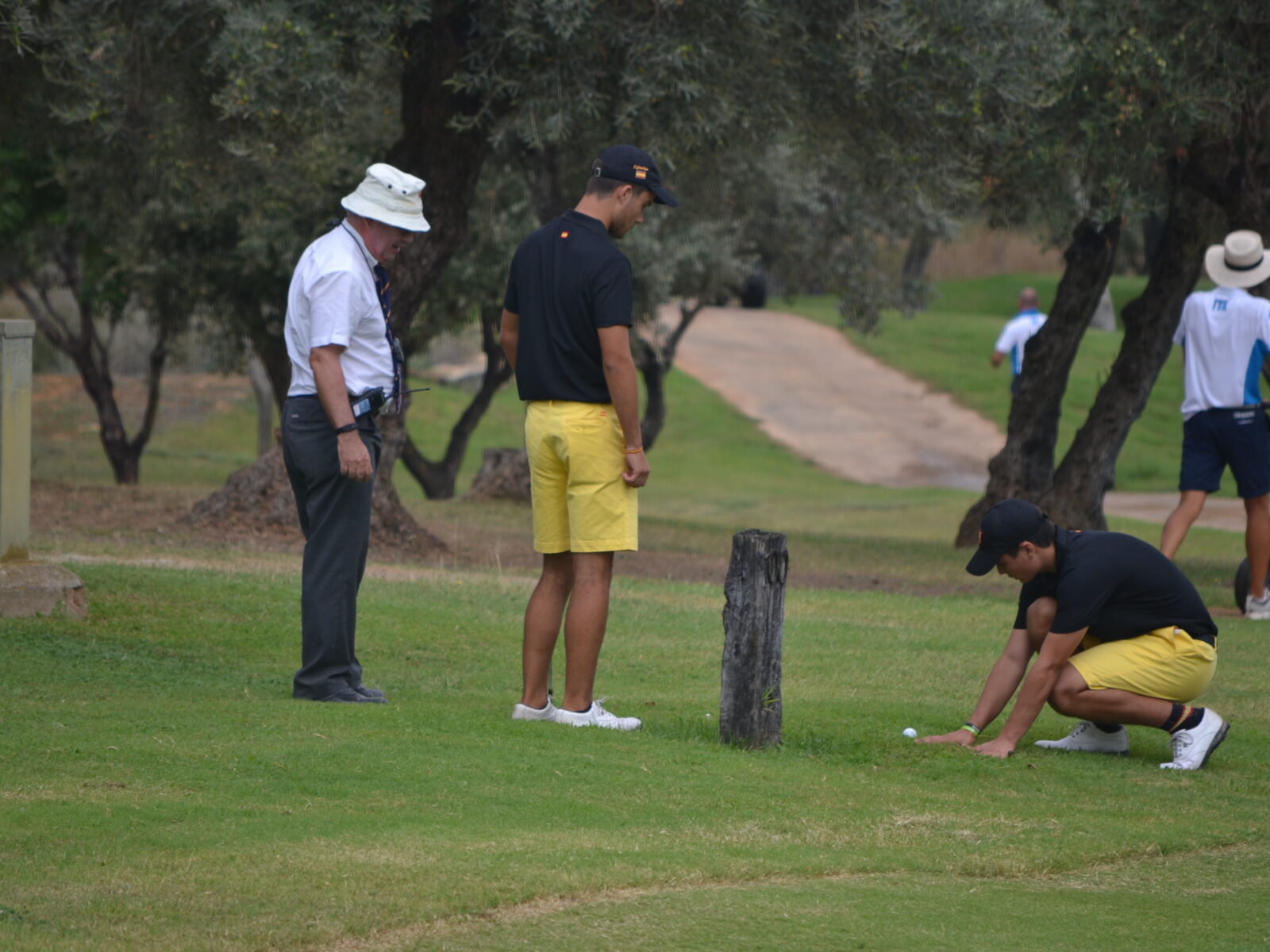


The RFEG Rules Committee has prepared a series of articles to further promote and teach the Rules of Golf, ensuring that playing our sport is as enjoyable as possible while always adhering to current regulations. The second article focuses on the often-unknown rules of Match Play.
The Rules of Match Play. Those great unknowns
The game of golf, in match play format, is full of surprises for the player when it comes to the Rules. Although it's very common in recreational golf to play a weekend round with friends in match play format, it's very common to hear absurdities like "I had to give him the hole because he went out of bounds" or "I played two balls because I didn't know if I was entitled to a relief" or "all the putts are given.".
Rule 3.2 Match Play Competitions answers all our questions. But what are the main differences in the Match Play Rules? Let's look at them one by one.
In Match Play, the game is played hole by hole. In this format, the winner isn't necessarily the player with the fewest strokes, but rather the player who scores one less than their opponent on the majority of holes. Each hole is like a "game" in tennis. You could say that a Match Play match is like a tennis set with 18 "games," but without the need to win by two holes.
The general penalty for breaching a Rule is the loss of the hole. This occurs when we play from the wrong place, play the wrong ball, move the ball and fail to replace it, touch the ground in a bunker before playing, or improve the swing area or the ball's lie. In Match Play, there is never a two-stroke penalty; the opponent is awarded the hole. However, the penalty is one stroke, as in Stroke Play, for moving or touching our ball, losing it, declaring it unplayable, cleaning it when not permitted, or dropping it incorrectly.
The players have the authority to apply the Rules. This might suggest that Match Play is played without Rules, but the reality is quite the opposite. The unique aspect of Match Play is that it empowers the players to resolve any issues that arise, to the point that a referee not assigned to the match has no right to intervene unless specifically requested to do so.
But what players cannot do is agree to disregard a Rule of Golf under penalty of disqualification. They cannot agree to give themselves putts of a certain length or agree to play only 18 holes when they were supposed to play 36. And they also cannot agree to play out of order except in the exceptional case of gaining time.
If the parties cannot reach an agreement, the aggrieved player is allowed to file a protest before teeing off from the next hole so that the Committee can adjust the result if necessary. If no protest is filed, the procedure used by the opposing player is deemed valid, even if it is not in accordance with the Rules of Golf.
And it's worth remembering that in Match Play, you can't play two balls like in Stroke Play. If a player does this, their opponent can claim the hole where it happened.
In match play, we're sometimes forced to repeat a shot. If we go out of bounds and have just hit the drive of our lives, there's no penalty, but our opponent can immediately make us repeat the shot. If, instead of going out of bounds, we land in the wrong hole, the procedure is the same, but our opponent is unlikely to be so lenient, and we'll have to continue playing with our ball and see how many strokes it takes us to get back to the correct hole.
The same applies if we play when our opponent should, because the order of play in Match Play is sacrosanct. Playing first is an inalienable right if our ball is farther from the hole than our opponent's. It's very common to think it's our turn if we're off the green and our opponent is on the green, but sometimes their putt might be longer than our approach.
If we don't know who should play first and no one can help us determine which ball is farthest from the hole, we have to do it by chance.
A stroke, a hole, or a match can be conceded. This is the key difference between Match Play and Stroke Play. While in Stroke Play you have to finish every hole, Match Play allows you to resolve the match, the hole, or the next stroke with a simple concession. And this concession cannot be refused or withdrawn.
The stroke can be conceded before it is taken. The hole is considered finished with the strokes taken plus the one conceded. The match and the hole can be conceded at any time as long as the match has not ended.
Players can agree to a tie on a hole, known as a "half," which is one of the most characteristic strategic elements of Match Play. Offering and accepting a "half" means the hole is tied, not that the remaining putts are awarded.
There are some other differences, but these are the most important. Match play provides moments of great intensity and can be played individually or in pairs. The Ryder Cup, held every two years, proves that this competition is the most vibrant and exciting in the world of golf.
Xavier Burjachs
International Referee Judge