Spanish golf, in the mid-1950s, finally achieved a millennial milestone. Not in terms of years, of course – that will come – but in another metric that is so fashionable today for quantifying the spectacular rise of this sport in our country: the number of registered players.
At just 417, when the aforementioned decade began, the Spanish Golf Federation established that the federation license should be mandatory to cover possible accidents during the development of the game, as well as to establish a more rigorous control of the handicaps of the players.
The aim was to ensure that competitions were as fair as possible and that the handicaps of participants in each championship were up-to-date. As a result, many players who had practiced the sport informally in the early 1950s regularized their status, leading to the achievement of 1,000 registered players in Spain by 1956.
The magazine 'Golf' is born‘
Just three years earlier, specifically in August 1954, another historic event for golf in Spain took place: the launch of 'Golf' magazine, the oldest publication of the sport in the country. Promoted by the Spanish Federation – the same one you hold in your hands fifty years later – it was initially intended to be a monthly publication, although it only achieved that status in February 1955, by which time it was more established.
As the Marquis of Bolarque—then President of the Federation—stated in the editorial of the first issue, the aim was to offer members and sports enthusiasts in general a platform for promoting the excellence of golf in our country. At that time, it must be acknowledged, the difficulties were immense, and there was no shame in admitting it. "What is already a popular sport worldwide, considered the healthiest medicine for those who perform strenuous intellectual work, is, on the contrary, in our country regarded as an elegant sport, accessible only to the privileged classes," was written verbatim in that first issue of 'Golf' magazine, which, according to its editors, was determined to dismantle this classist concept as quickly as possible.
Popularization was already one of the main federative objectives, a dynamic that would take many years to materialize, but which by the mid-fifties was already one of the reasons for the existence of the Spanish Golf Federation.
Even if only slightly, other purely sporting aspects contributed to the always complicated task of attracting the attention of fans who didn't play the sport. Of particular note, within a fairly broad group, was the successful participation of the Spanish team in the 1954 International Pentagonal Match. That competition was the precursor to the current European Team Championship, a tournament with deep roots today, but which at that time only included five participating countries.
In that year the organization was in charge of the French Federation, whose President, Jacques Leglise, chose the New Golf de Deaville to host the event, a good course, complicated most of the time due to the presence of a variable but perennial wind from the nearby English Channel, which radically changed the playing conditions from one day to the next.
A vibrant competition
The Spanish team, like the rest of the participants – Portugal, Italy, Switzerland and France as host – arrived five days before the first official match, more than enough time to familiarize themselves with the course, a par 72 of hard and high rough with greens of all possible characteristics.
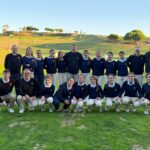
The competition was a thrilling affair, with special mention for the performance of the Spanish team, captained by Enrique Maier and made up for the occasion of HRH the Count of Barcelona – who had a handicap of 5 –, Luis Rezola, Juan Antonio Arana, Iván Maura, Ricardo Santos, Ricardo Gómez Acebo, Álvaro Rezola and Juan Antonio Andreu.
Not surprisingly, Spain finished second to the French hosts, distinguishing themselves as the only team to defeat the eventual champions in a round-robin tournament. Given the odd number of participants, a draw was held to determine which team would have a bye. This draw proved detrimental to Spain, as they had to play the first four days consecutively, and then, ironically, faced the team that had been scheduled to have a bye the previous day.
A comfortable victory against Portugal (6.5 points to 2.5), a more challenging one against France (5 to 4), an untimely setback against Italy (3 to 6), and a draw against Switzerland at 4.5 points after a very intense and exciting duel summarize a convincing performance that took the Spaniards to second place, with special mention for the quality and determination of Iván Maura –Spanish champion in 1952 and 1953, one of the best European players of the time, who had just won the Spanish Amateur International and the Puerta de Hierro Cup–, the consistency and effectiveness of Enrique Maier, the power in the long game of Luis Rezola, the skill of HRH the Count of Barcelona in the short game, and the experience of Juan Antonio Arana, always a reference for the three newcomers of the group, Ricardo Santos, Ricardo Gómez Acebo and Álvaro Rezola, who were making their debut in international competitions.
Rejoicing in the success achieved in France, other, more domestic initiatives were underway to popularize golf in Spain. Among these, a notable one was the organization of a simultaneous competition across several courses in Spain for a trophy donated by… the Royal Spanish Football Federation. The allure of football was already irresistible, but this one-off collaboration was curious, designed to put into practice a principle highlighted in a sidebar in the first issue of 'Golf' magazine: ‘Golf makes you forget your worries and takes business off your mind. It increases camaraderie with friends, mutual understanding, and cordiality among opponents.’ Looking back fifty years later, this sentiment certainly rings true.