As we mentioned yesterday – or rather, as we mentioned in the previous issue – the unstoppable spread of golf, originating in the British Isles, finally took hold in Spain at the end of the 19th century, specifically on another island, the beautiful Gran Canaria, where a group of English residents took the necessary steps to fill their leisure time with their favorite sport. In 1891, on the estate known as 'Lomo del Polvo', the first golf course in Spanish territory was officially established, later becoming the Real Club de Golf de Las Palmas. The assault on the Iberian Peninsula was imminent.
On the outskirts of Madrid
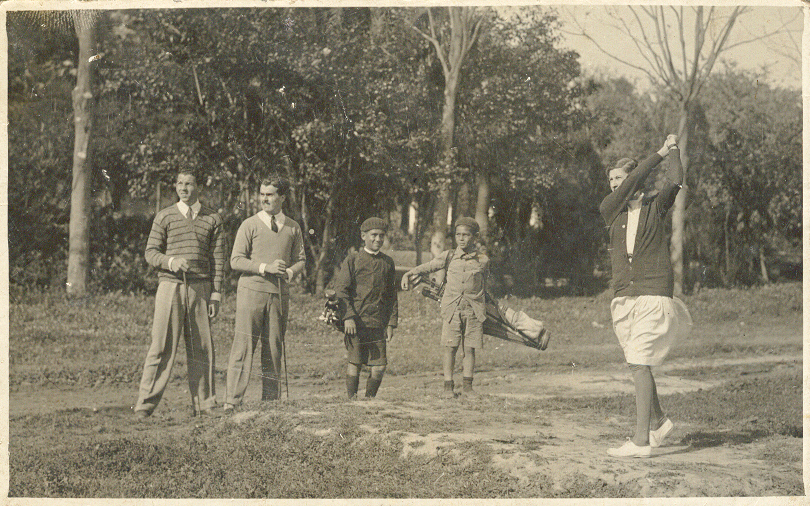
Thirteen years had to pass before that reality materialized. At the beginning of the 20th century, golf was a fledgling activity practiced by only a few enthusiasts. The difficulty in finding land—then, as now, they had to contend with these problems—and its high cost delayed the execution of any project. One, however, was soon successfully completed, paving the way for others to be carried out more quickly.
It was, in what were then almost the outskirts of the capital of Spain, the 'Madrid Polo Golf Club', a mixed name to better reflect the character of facilities that, founded in 1904, were located in the Castellana racecourse, more specifically in the area called 'Cuarenta Fanegas'.
However, that Polo and Golf Club didn't stay in that location for long. Just ten years later, in 1914, it moved to the vicinity of the 'Iron Gate', on one of the city's exits, thanks to a land donation from His Majesty King Alfonso XIII and the direct intervention of the Duke of Alba, a polo enthusiast. The change of address also led to a change in its name, becoming the 'Royal Club of the Iron Gate', where the first official championships recorded in Spain soon began to be held.
The Count of Cuevas, in 1915, and the Count of Cimera, in 1916, both from Puerta de Hierro, inscribed their names on the most extensive list of winners of any competition held in Spain. Indeed, the Puerta de Hierro National Cup, as the tournament was called, has been played uninterruptedly ever since, with the sole exception of the civil war that ravaged our country between 1936 and 1939. During this time, it became a true Spanish Amateur Championship until 1940, after the war, when the latter competition acquired its own official status, independent of the Puerta de Hierro National Cup. The latter, however, maintains its importance and awards the club of the winning player the right to organize the following edition.
The dominance of the Puerta de Hierro players was, however, brief. A series of Basque golfers from Neguri burst onto the national scene with unexpected force, first with Luis Olabarri and Tomás Olabarri at the forefront and, a little later, with the Arana family (Luis, Javier, Luis Ignacio) sweeping all the titles in the aforementioned Puerta de Hierro National Cup year after year until the end of the 1940s.
A whole empire
The Royal Golf Society of Neguri was a veritable empire. Founded in 1911, just a few months after the San Sebastián Golf Club, on land located within the jurisdiction of Lejones and Neguri, it immediately attracted the attention of the most prominent members of Basque society. That first course was small, with only 11 holes, and its layout made expansion impossible. Therefore, it soon moved to a new location, 16 kilometers from Bilbao, on a magnificent cliff overlooking the Cantabrian Sea, offering spectacular views.
At that time, Neguri rivaled the San Sebastián Golf Club, located in the Lasarte Valley, in importance. Interestingly, its fate, like Neguri's, lay far from those lands, in this case driven by the growing pressure of Basque industry, which eventually surrounded the area entirely. Consequently, it relocated to Mount Jaizkibel, a beautiful spot as can be seen today along the road connecting San Sebastián and Hondarribia. Taking advantage of this location, the original 9-hole course was expanded to the current 18-hole course.
The Real Golf de Zarauz, inaugurated in 1916, completed the golfing offer in the Basque Country before the end of the 1910s. Close to the sea, it fulfilled the golfing desires of fans in this important holiday center, an objective that it continues to faithfully fulfill to this day.
Catalonia was not immune to this contagious golf craze. In 1912, a nine-hole course was inaugurated in a picturesque valley near the Royal Palace, just six kilometers from the center of Barcelona. As in previous cases, the 'Mare Club de Golf de Pedralbes,' as those facilities were called, was eventually overwhelmed by the unstoppable expansion of the Catalan capital and had to be closed so that its land could be used for other purposes. In its place, the Real Club de Golf El Prat was founded on the land now occupied by the airport, becoming one of the most successful golf clubs in the history of Spain and Europe. We will give a full account of its history and the contagious spread of this green spirit to other areas of Catalonia, Cantabria, and Andalusia in the next issue.