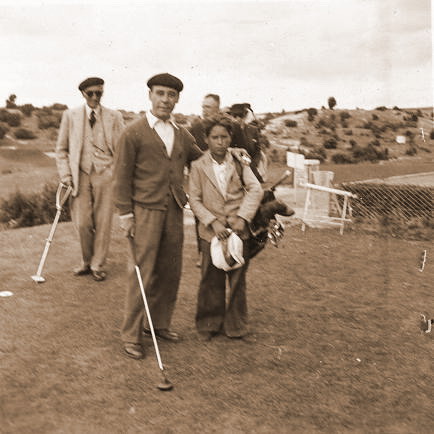
Who said that golf is a new hobby in our country? You only have to look at the photos on these pages to realize that the sport of club and ball already had a multitude of fans many years ago, when photos had to be developed in that attractive black and white and many players adorned their heads with an elegant wide-brimmed hat while practicing their favorite sport.
At a private residence
Did you know, for example, that the Spanish Golf Federation was founded in a private residence and that, in its early days, it moved around during the summer months? Well, indeed, according to a letter that can still be seen in the office of the current president, the Royal Spanish Golf Federation was founded on October 9, 1932, at the private residence of Mr. Luis de Olabarri, located in Las Arenas, Getxo, in a meeting attended by representatives of the Country Club (Pedro Cabeza de Vaca), Puerta de Hierro Club (Pedro Gandarias), Lasarte Club (Santiago Ugarte), Pedreña Club (Marcelino Botín), Neguri Club (Luis de Olabarri), and Seville Club (Javier de Arana).
They all reached the following agreements:
“1.- To establish the Federation of Golf Clubs of Spain, which will be made up of the Clubs represented here and as many more as may request it under the proper conditions.
2. The name of said federation shall be “Federation of Golf Clubs of Spain”. Its registered office shall be the Puerta de Hierro Club, Madrid, except for the months of June to October inclusive, when, by order of draw, the Secretary shall reside in one of the following Clubs: Pedreña, Lasarte and Neguri.
3. The Secretary is authorized to, as soon as possible, and once the Statutes have been approved, which will conform to the bases indicated below, give legal status to the Federation…
The crowded signatures of the six attendees, along with some curious sums located in the lower left part of the page (208 plus 11 and 210 plus 35, perhaps the number of players? a possible budget?) complete the brief act of constitution.
Since then, what was an endeavor led by those few people eager to establish a legal and organizational framework for the then elitist sport of golf, has become a huge undertaking that accommodates the spectacular increase in members with which the 20th century ended, specifically 175,444 people, a figure now outdated compared to the nearly 235,000 members who, just three years later, are watching us, placing golf, according to the number of licenses, in fourth place among all the sports practiced in our country, after football, hunting and basketball.
The growing popularity of golf and the construction of public courses have generally been the focus of federation activity in recent years, whose spectacular evolution is evident in a couple of figures: barely 2,500 members in 1966; 91 courses in 1989, 232 in 2000, almost 250 in 2003. Those days when the Real Club de Golf de Las Palmas, in Gran Canaria, was inaugurated in 1891 seem a distant memory…
Players with a history
And what memories do golfers of the caliber of the brothers Miguel, Ángel, and Sebastián, or the beloved Luis Ignacio Arana, Iván Maura, Ramón Sota, or Ramón Tayá evoke for you—to name just a few significant examples from before the more recent José María Cañizares, Manuel Piñero, Antonio Garrido, or the immeasurable Severiano Ballesteros, a fundamental pillar in the history of Spanish golf? What was the contribution of the pioneering female players in Spain, those (Merche Artiach, Elvira Larrazábal, Carmen Maestre, etc.) who have passed the torch to the current generations?
These pages mark the beginning of a series of stories from the past, not strictly chronological, chosen from here and there, from this year and that year, always united by their intrinsic historical interest. Sometimes they will focus on a particular competition; at other times, on a central figure who has been involved in countless anecdotes. All the players mentioned above, and many more, as well as the most significant Championships in the history of Spanish golf and their main anecdotes, will have a place in these pages. We apologize in advance if the sources consulted—sometimes simply the memory of someone—do not definitively establish the exact date on which a specific event actually occurred, although everyone can rest assured that the information will be very, very close to the truth.
The sport of golf arrived in Spain, of course, much later than when some shepherds in Scotland began hitting a ball with a stick in one of the endless meadows of the Scottish countryside. This event, dated to the 15th century and confirmed by some paintings from that period and by the Scottish Parliament's prohibition—a bad start indeed—of playing golf in 1457 due to the excessive popularity of an activity that interfered with the practice of archery, essential for national defense.
We will give a good account in the following chapters of these stories from the past of golf, with the direct intervention of the Archbishop of St. Andrews and the magistrates of Edinburgh, as well as its unstoppable expansion to all corners of the world, in order to pay tribute to its main protagonists, which is very useful to understand the current 'boom' of this sport in our country.