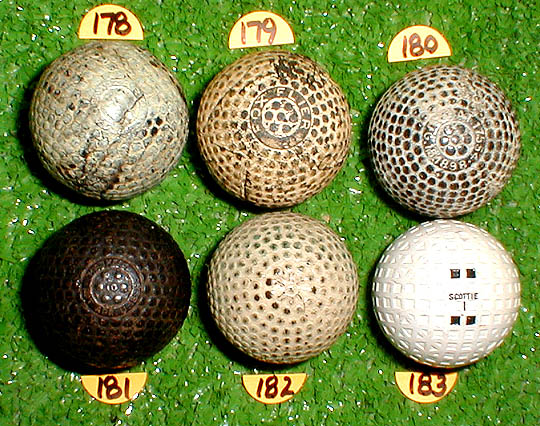
To understand the history of golf, it helps to understand the different types of golf balls that have been used. An important element in the evolution of golf balls is the variety of materials used to manufacture them. Each new material changed the characteristics of the ball's flight. Each type of ball used affected aspects of the game such as club design, playing style, and course length. Between 1400 and 1960, there were four distinct periods based on the type of ball used.
The wooden ball period
Not much information remains from this period. The wooden balls were made from hardwood trees, such as the root. They were probably used between 1400 and well into the 17th century. This is based on conjecture derived from the written records that have been found, as virtually no artifacts from this period exist.
The period of the leather ball
We can say that this period begins in the 1400s or 1600s and ends around 1850. The balls used until 1700 could have been made of wood or leather filled with wool or hair.
The leather balls were made from three pieces of hide, each 1/16 of an inch wide, usually bull or horse hide. These pieces were closed with two rectangular pieces, each 5/32 of an inch wide. The filling was made of goose or chicken feathers. When the ball was wet, the hide tended to shrink, compressing the feathers as it dried, while the feathers tended to expand upon drying. The combination of these two actions produced a hard, playable ball.
Once finished, the ball was painted white to make it more visible. Initially, there was probably no standard for size, weight, or manufacturing method. The ball's number indicated its size, but later came to indicate its weight. Golfers chose their ball based on their skill level and the course conditions.
Although you couldn't change balls during a hole, you could change them at the start of a new hole. If a ball in play was damaged, it had to be played to finish the hole. Good shots affected the ball, but a bad shot could destroy it. The game relied more on finesse than distance.
Under normal conditions, the average driving distance was between 135 and 165 meters. The holes were shorter than they are today.
It was easy to cut a leather ball. Until 1800, the clubs used were almost exclusively wooden. Iron clubs were usually used when the ball was in a bad position where a wooden club could be damaged.
The leather balls weren't perfectly round. Despite this, they flew and rolled quite well. On the hard surfaces of the greens of that era, these balls were more accurate than on today's perfectly smooth greens.
Although leather balls were the predominant technology for hundreds of years, they had two major disadvantages: their durability and the difficulty of obtaining them.
The period of the Gutta Percha ball
In the early 1850s, gutta-percha balls transformed leather balls into collector's items. The gutta-percha ball period spans from approximately 1848 well into the 1900s. Gutta-percha is a rubber-like material derived from trees native to East Asia. Early gutta-percha balls were made by heating the material in water. They were then shaped into rounds by hand while still warm.
After a few years, metal molds began to be used. A good ball manufacturer could make at least six dozen balls a day, 25 times what a leather ball manufacturer could produce. This volume of production caused the price of golf balls to drop by half, allowing golfers with lower incomes to join the game.
Reverend James Paterson is credited with making the first gutta-percha ball in 1845. This ball was known as the Paterson patent ball, and it was manufactured to physically resemble a leather one.
Players soon began to realize that their shots were more predictable. This led to the addition of markings on the surface of the ball in an attempt to achieve greater aerodynamic stability. The first markings simulated cuts made with an iron.
Around 1880, the markings were made directly with the mold. The first patterns used for the markings were circular, radiating from the poles of the ball. In the 1890s, dozens of exotic patterns were developed.
The average distance with the driver of a normal player using a gutta percha ball was between 155 and 170 meters, about 25 meters more than with a leather one.
The hardness of the gutta-percha balls meant they weren't easily cut when struck with irons, but the large-headed wooden clubs used for playing leather balls didn't allow for repeated, centered shots with the new gutta-percha balls. The profile of the club heads became thinner.
Striking a gutta percha ball produced a sound similar to that produced by two billiard balls colliding with each other.
Like leather balls, gutta-percha balls had several drawbacks. Due to their hardness, they often damaged the faces of the fairways. Many players disliked the sound and feel, resisting the change from leather balls. On cold winter days, gutta-percha balls tended to crack. This led to a rule change to prevent a ball from breaking during a hole. The player was allowed to drop a ball as close as possible to the largest piece of the broken ball. On hot summer days, gutta-percha balls would soften and not travel as far as usual. But none of these problems diminished the popularity of these balls.
The balls, once molded, were dark brown. They were painted and ready to play. After several games, they had to be repainted.
If they were reheated, they could be remolded, thus recovering the old balls which were resold at a lower price than the new ones.
Gutta-percha balls replaced leather balls due to their lower cost and superior qualities. When rubber-coated balls replaced gutta-percha balls, it was because of their improved playability and greater distance, despite costing almost twice as much.
The period of the rubber core ball
It began in the late 1890s. Initially, the balls were made by hand by weaving tightly stretched elastic bands around a rubber core. They were then coated, first with gutta-percha and later with balata and other materials. In 1900, the ball-weaving machine was patented, allowing for the mass production of the rubber-core ball.
The distance with the first rubber balls was between 190 and 245 meters. The ball was easier to hit, so you didn't need to be as skilled to play. Courses had to be lengthened, and par fives became par fours. More clubs were used, although the limit was already set at 14, which improved scores, changed the game's strategy, and led to changes in course design.
Early rubber balls didn't land as softly as gutta-percha balls because they tended to bounce. Part of this problem stemmed from the type of mold used. By the early 1900s, the molds had been improved. The problem of the ball not landing softly changed playing strategies. By the end of the decade, this problem was solved by improving aerodynamics and spin.
Initially, leather balls were more expensive than gutta-percha balls. After a few years, the price gradually decreased until it became affordable for players.